
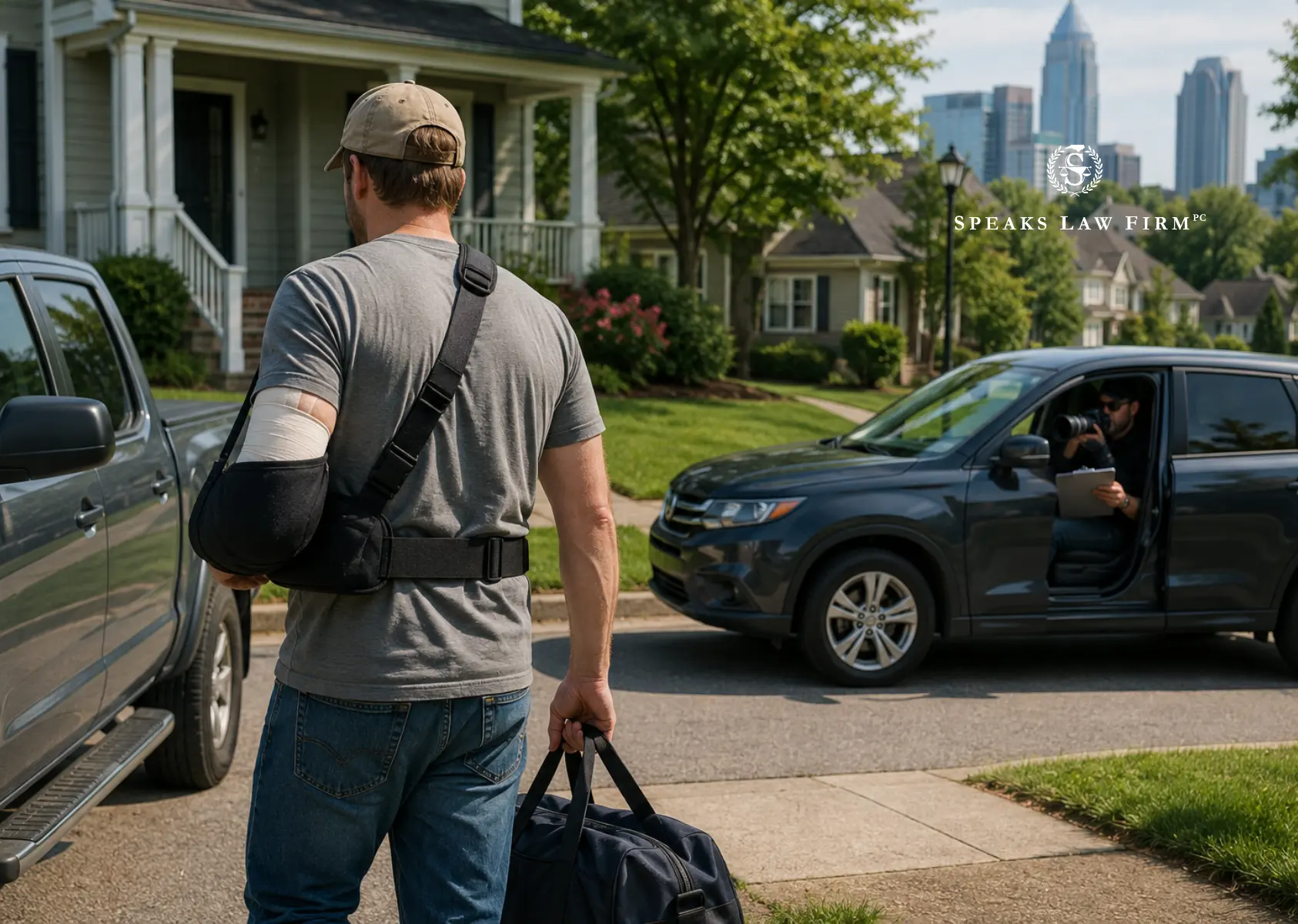
You filed a workers’ compensation claim after suffering a workplace injury. Now you’re focused on healing, attending medical appointments, and following your doctor’s treatment plan. Then something catches your attention. The same unfamiliar vehicle appears near your home more than once. Someone seems to be watching you while you shop for groceries or leave physical therapy. You begin to wonder whether the insurance company hired someone to investigate your claim.
While that situation can feel invasive, it’s not uncommon in some workers’ compensation cases. Insurance companies may hire private investigators to determine whether an injured worker’s reported limitations are consistent with their observed activities. Investigators may conduct surveillance, review publicly available social media activity, interview individuals familiar with your daily routines, and gather other information they believe is relevant to a workers’ compensation claim.
That does not mean every injured worker is placed under surveillance or that investigators have unlimited authority. North Carolina law still places limits on what investigators may do, and surveillance evidence must be evaluated alongside your medical records, doctor’s opinions, and the facts of your claim.
Recognizing how workers’ comp investigator tactics are used can help you avoid mistakes that could complicate your claim and better protect your ability to pursue the workers’ compensation benefits you may be eligible to receive under the law. Below, you’ll learn how investigations work, the surveillance tactics insurance companies often use, what investigators can and cannot legally do, and practical steps you can take to protect your claim throughout the process.
At a Glance
- Insurance companies sometimes hire private investigators to verify reported injuries and evaluate workers’ compensation claims.
- Workers’ comp surveillance may include video surveillance, photography, social media monitoring, public records searches, and interviews with co-workers or neighbors.
- Surveillance conducted in public spaces is often legal, but investigators cannot trespass onto private property or enter your home without permission.
- Even seemingly harmless public social media posts may be used as surveillance evidence if they appear inconsistent with your reported limitations.
- Following your doctor’s restrictions, attending medical appointments, and being truthful about your physical abilities can help protect your workers’ compensation claim.
- A workers’ compensation lawyer can explain your legal options if surveillance or other insurance company tactics threaten your claim.

Why Would an Insurance Company Investigate a Workers’ Compensation Claim?
Not every workers’ compensation claim leads to surveillance. However, insurance companies have a financial interest in evaluating claims carefully before paying workers’ comp benefits for medical care, lost wages, and other covered expenses. One way an insurance company may attempt to verify a claim is by hiring a workers’ comp private investigator to collect information about an injured worker’s activities.
In many situations, investigators are not looking for dramatic evidence of fraud. Instead, they are trying to determine whether your observed physical activity appears consistent with your reported injuries, medical records, and the restrictions your treating physician has placed on your daily activities.
For example, if you’ve reported a serious back injury that limits your ability to lift heavy objects, an investigator may look for evidence showing whether your activities in public match those reported limitations. Likewise, if your doctor tells you to avoid certain movements while recovering, investigators may attempt to document whether your actions appear consistent with those instructions.
Insurance companies may also review workers’ comp surveillance evidence when:
- The circumstances surrounding an injury claim are disputed
- Reported limitations appear inconsistent with other available information
- Witness statements conflict with the injured worker’s account
- The employer or insurance carrier raises questions about the claim
- The claim involves significant medical bills, ongoing disability benefits, or an extended period away from work
It’s important to remember that surveillance alone does not determine whether a claim is approved or denied. The North Carolina Industrial Commission evaluates workers’ compensation claims based on the available evidence, including medical records, physician opinions, testimony, and other relevant documentation. Surveillance footage is only one piece of that larger picture.
What Workers’ Comp Investigator Tactics Are Common?
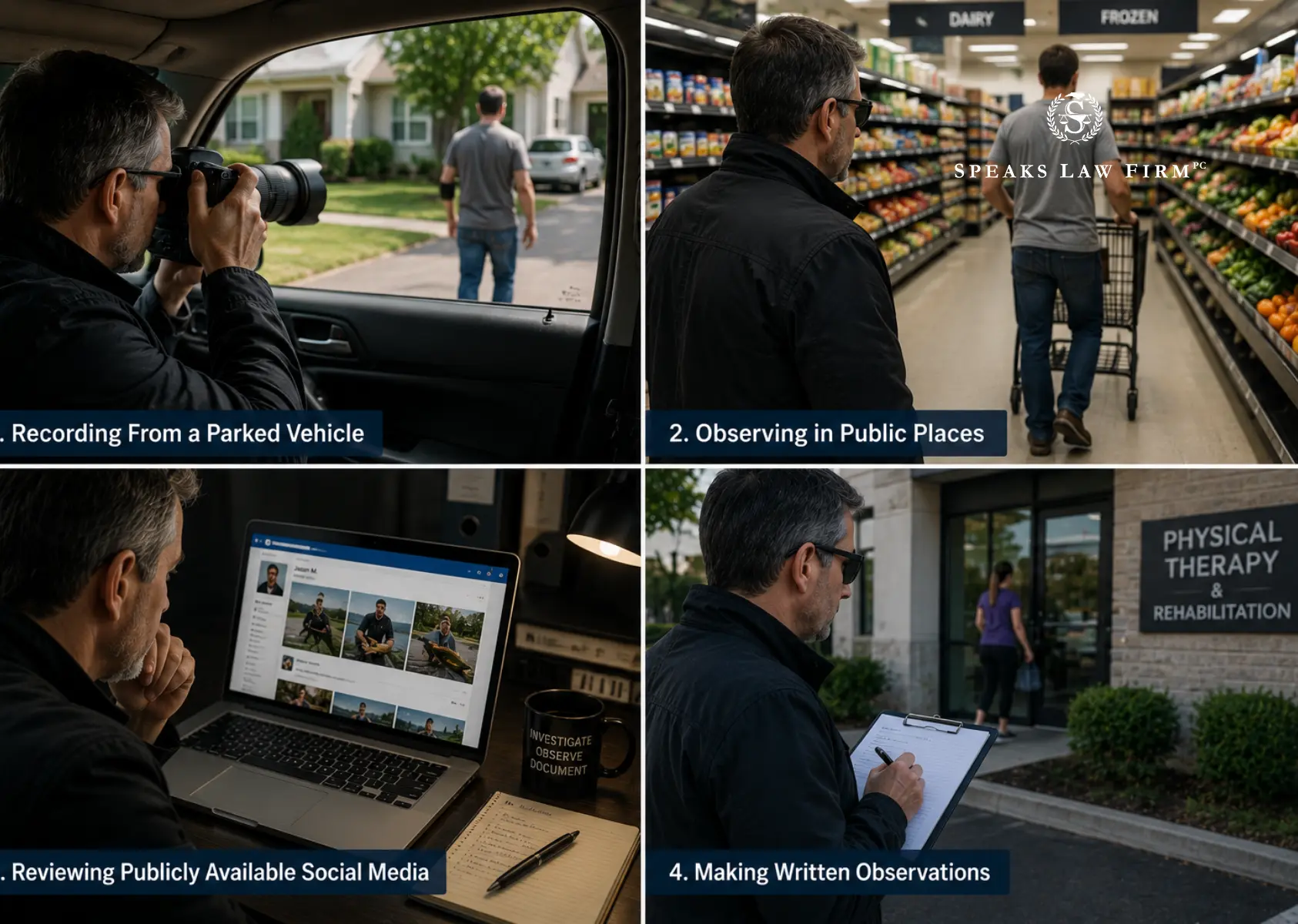
Private investigators use several forms of surveillance and research to collect evidence they believe may support or challenge a workers’ compensation claim. Depending on the circumstances, the investigation may last a single day or continue over several weeks.
Below are some of the most common tactics investigators use.
Video Surveillance in Public Places
One of the most recognizable workers’ comp surveillance methods involves video surveillance. A private investigator may observe an injured worker while they enter or leave their home, drive to work, attend medical appointments, shop for groceries, visit a gym, or perform other routine activities in public spaces. Investigators often position themselves where they can lawfully observe activity from public roads or sidewalks without entering private property.
The goal is to capture footage the insurance company believes may either support or call into question the limitations described in your workers’ compensation claim.
For example, investigators may record someone:
- Carrying groceries
- Walking without an assistive device
- Loading items into a vehicle
- Performing heavy lifting despite claiming significant physical restrictions
- Participating in recreational activities
One short video clip, however, rarely tells the entire story. A few moments of physical activity may not reflect the pain that followed, the medical restrictions that remained in place, or whether the activity exceeded your doctor’s recommendations. Surveillance footage should always be considered alongside your complete medical history and the opinions of your treating physician.
Social Media Monitoring
Another increasingly common tactic is social media monitoring. Many investigators routinely review publicly available social media profiles and social media accounts looking for photos, videos, comments, location check-ins, or other information that appears inconsistent with a claimant’s reported injuries.
Even an innocent photograph can create questions if it lacks important context. For example, a single photo showing you smiling at a family gathering does not necessarily reveal how much pain you experienced before or afterward. Likewise, a brief video of you helping move a lightweight object may not accurately represent your physical limitations or the full extent of your recovery.
Because investigators may review public social media activity, it’s wise to think carefully before posting updates while your claim remains active. Many attorneys recommend that injured workers avoid posting details about their injury, recovery, or physical activities until the claim is resolved.
That doesn’t mean you have to disappear from social media altogether. It simply means recognizing that public posts may become part of the evidence reviewed during your case.
Following Daily Activities
Investigators may also conduct surveillance over multiple days to observe your normal routines. Rather than focusing on a single event, they may watch whether your observed activities consistently align with your reported limitations. This could include documenting when you leave home, where you travel, how long you’re away, or whether your daily activities appear consistent with the restrictions recommended during your medical treatment.
In some situations, an investigator may use unfamiliar vehicles or change observation locations to avoid drawing attention. While this type of surveillance can understandably feel invasive, observing activities that occur in public places is often lawful when conducted within applicable privacy laws.
The important point is not to change your behavior because you think someone may be watching. Instead, continue following your doctor’s recommendations, attend your scheduled medical appointments, and avoid activities that exceed your documented restrictions. Acting consistently with your medical condition is often the strongest way to protect your claim.
Do Workers’ Comp Investigators Interview Other People?
Depending on the circumstances, investigators may speak with individuals who could have information relevant to your workers’ compensation claim.
For example, an investigator may attempt to interview:
- Co-workers
- Neighbors
- Family members
- Other potential witnesses
These conversations are intended to gather evidence about your reported injury, physical abilities, work activities, or daily routines. Someone may be asked whether they have observed you performing certain tasks, returning to work, or engaging in physical activities that appear inconsistent with your reported limitations.
Keep in mind that these individuals are not required to speculate about your condition or offer medical opinions. Likewise, an investigator cannot force anyone to participate in an interview.
If friends, relatives, or co-workers tell you they were contacted about your claim, remain calm. Continue following your treatment plan and discuss any concerns with your workers’ comp attorney before making assumptions about how the information may affect your case.
Can Background Checks Become Part of a Workers’ Compensation Investigation?
Background checks and public records searches are another tool investigators may use. Depending on the circumstances, an investigator may review information that is legally available to the public, including:
- Property records
- Court filings
- Business ownership records
- Professional licenses
- Publicly available employment information
The purpose is often to identify conflicting information that could affect the credibility of an injury claim.
For example, if someone reports being completely unable to work but public business records indicate they are actively operating a company, the insurance company may investigate further to better understand the situation.
Public records alone rarely determine whether a claim is approved, denied, or otherwise affected. Instead, investigators use them to develop a broader understanding of the facts before presenting information to the insurance carrier.

What Workers’ Comp Investigators Cannot Legally Do
Many injured workers worry that investigators have unlimited authority.
They don’t.
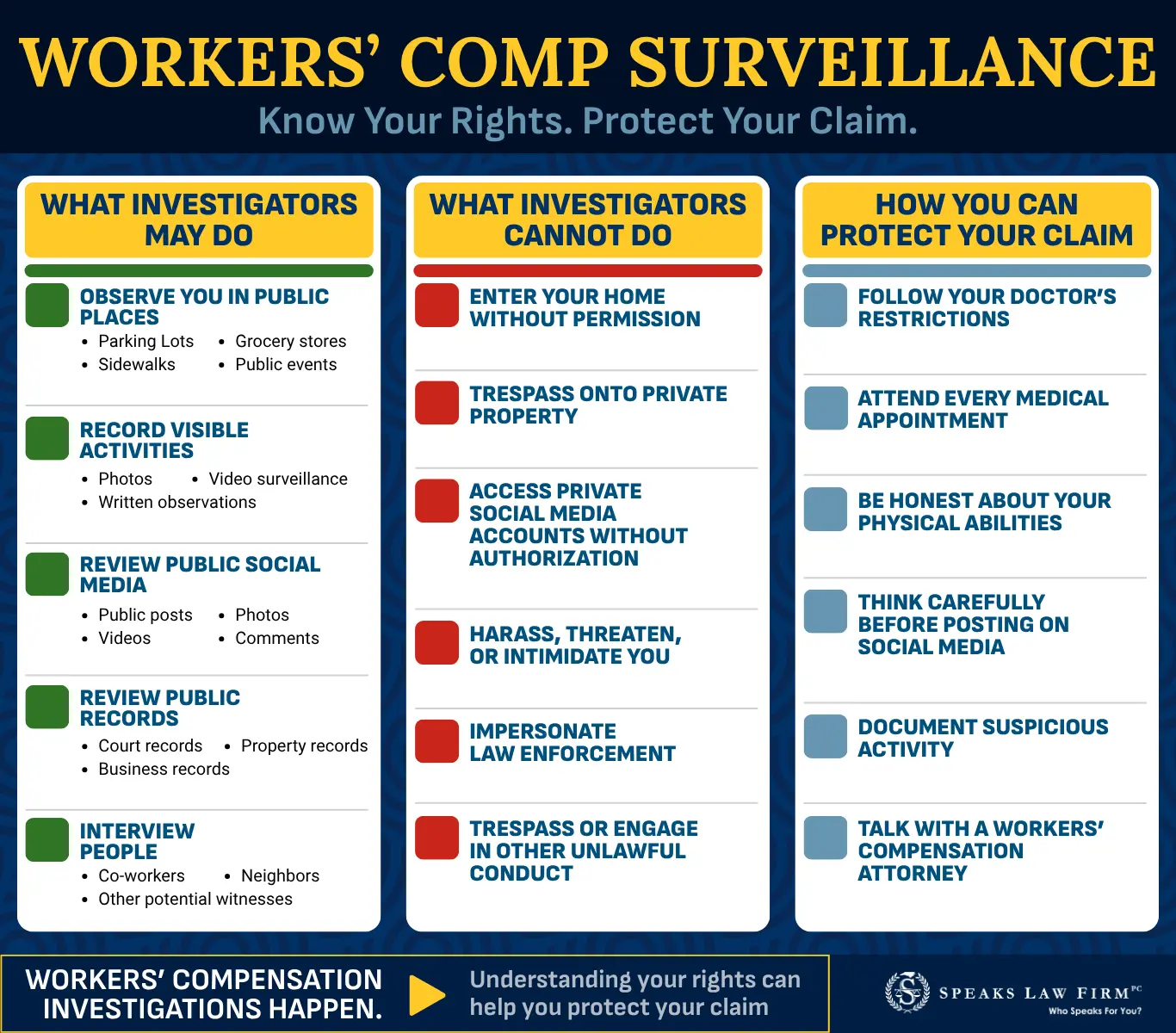
Although workers’ comp surveillance can involve extensive observation, investigators must still comply with applicable laws and professional standards. For example, investigators typically cannot:
- Trespass onto private property where they do not have permission to enter
- Enter your home without your consent
- Record activities occurring inside your residence without legal authorization
- Harass, threaten, or intimidate you
- Access private or password-protected social media accounts without authorization
- Misrepresent themselves as law enforcement officers
Much of the surveillance conducted during workers’ compensation cases occurs in public spaces, where individuals have a lower expectation of privacy. That is why investigators often observe claimants while shopping, attending appointments, walking through parking lots, or performing other activities visible from public areas.
Knowing these legal boundaries can help reduce unnecessary anxiety if you suspect someone is observing you.
Can Surveillance Hurt Your Workers’ Compensation Claim?
Potentially, yes. The purpose of surveillance evidence is often to challenge the credibility of a claim by suggesting your observed activities differ from your reported condition.
For example, an investigator may argue that surveillance footage showing an injured worker lifting heavy boxes conflicts with medical records describing significant lifting restrictions. However, surveillance rarely tells the entire story.
A short video may not show:
- Pain that developed afterward
- Medical advice permitting limited activity
- Whether the activity occurred only once
- Necessary modifications made because of the injury
- The full extent of your recovery process
The North Carolina Industrial Commission considers many different forms of evidence, including medical records, physician opinions, testimony, and other documentation. In some cases, surveillance evidence may also influence settlement negotiations, particularly when the insurance company disputes the extent of an injury. One surveillance video is only one part of the overall evaluation.
Can One Good Day Be Used Against You?
Many injured workers worry that one afternoon of feeling better could jeopardize their workers’ compensation claim.
Recovering from a workplace injury is rarely a straight line. Depending on the nature of your condition, you may have days when you can comfortably complete certain tasks and other days when pain, stiffness, or fatigue significantly limit your activities.
For example, someone recovering from a back injury may be able to shop for groceries or attend a family gathering on a good day but need to rest afterward because of increased pain or discomfort. A brief surveillance video capturing only part of that day may not show the physical limitations you experienced before or after the activity.
Likewise, a single observation does not necessarily establish that you can return to work or perform your regular job duties without restrictions. Medical records, your treating physician’s opinions, diagnostic testing, and other evidence all play an important role in evaluating your condition.
Rather than avoiding all normal activities out of fear of surveillance, focus on following your physician’s recommendations, staying within your documented restrictions, and being honest about your physical abilities. Consistency between your medical records, your reported limitations, and your daily activities is often far more important than one isolated moment captured on camera.
What Can Trigger Surveillance During a Workers’ Compensation Claim?
Not every workers’ comp claim leads to an investigation. However, certain circumstances may trigger surveillance because they prompt an insurer to look more closely at a claim.
Possible red flags include:
- Inconsistent medical records
- Delays in reporting the workplace injury
- Witness accounts that conflict with your description of the accident
- Significant differences between your reported limitations and observed activities
- Ongoing disability benefits over an extended period
- Anonymous reports suggesting inconsistent physical activity
It’s important to remember that the presence of one or more red flags does not mean your claim lacks merit. Many legitimate workers’ compensation cases involve complex medical issues that require additional investigation before decisions are made.
Practical Ways to Protect Your Workers’ Compensation Claim
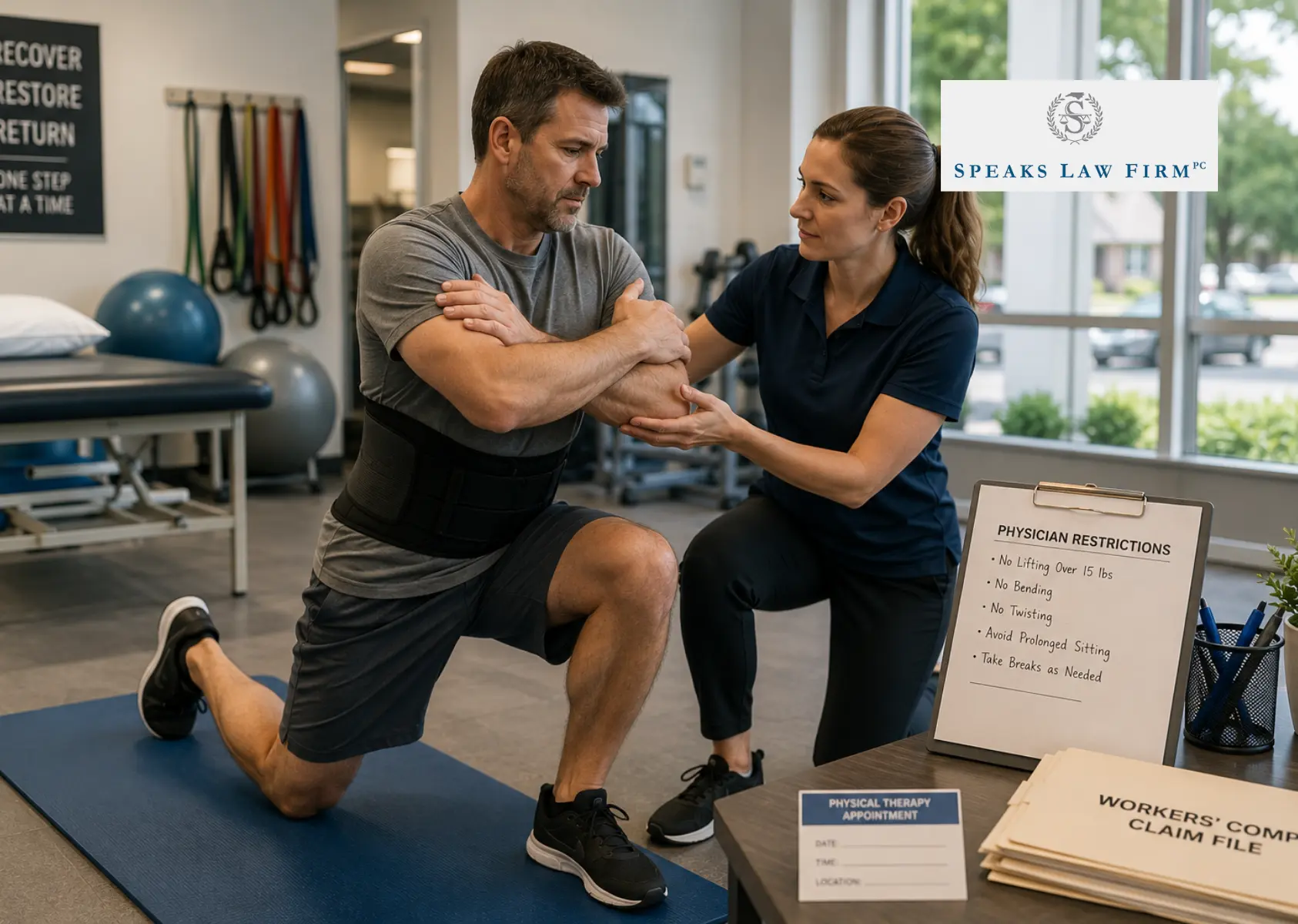
If you believe someone may be watching you, resist the urge to change your normal routine simply because you suspect workers’ comp surveillance. Instead, focus on protecting your health and documenting your recovery.
Follow Your Doctor’s Restrictions
One of the most effective ways to protect your claim is to follow your doctor’s restrictions consistently. Attend scheduled medical appointments, participate in recommended medical treatment, and avoid activities your physician has advised against.
Be careful not to over exaggerate your condition. 10/10 pain is the worst pain imaginable. If you can still function but pain is limiting your ability to do so, you do not have 10/10 pain. It’s probably more like 5-8/10. Likewise, if you tell your doctor you never do something or cannot stand or lift anything, then surveillance can become a very effective tool. All it has to show is you doing the activity you told the doctor you could not do. But if you are honest with the doctor about your abilities, surveillance is more likely to reflect what you advised your doctor.
Consistently following medical advice helps demonstrate that you are taking your recovery seriously.
Be Careful With Social Media
Public social media posts often become part of workers’ comp surveillance investigations. Before posting, ask yourself whether someone unfamiliar with your situation could misunderstand the photo, video, or comment.
As a general rule, if you do not want what you posted to be shown on a big screen in court during your case, do not post it.
A smiling picture at a birthday party does not necessarily reflect your physical condition, but without context, it could raise unnecessary questions. Because investigators may review public social media activity, thinking carefully before posting updates while your claim remains active can help avoid unnecessary questions.
Finally, privatize your account so that it is not accessible to the general public.
Be Honest About Your Abilities
Never exaggerate your limitations. Likewise, don’t minimize your symptoms simply because you want to appear capable.
Being truthful with your doctors, your attorney, and others involved in your workers’ compensation claim creates consistency throughout the process.
Document Suspicious Activity
If you repeatedly notice unfamiliar vehicles, believe someone is following you, or observe unusual behavior around your home, make a written report of what you observed.
Include:
- Dates
- Times
- Vehicle descriptions
- License plate numbers if visible
- Photographs when it is safe to do so
Avoid confronting anyone you believe may be conducting surveillance. Instead, share the information with your attorney so they can determine whether additional action is appropriate.
Common Myths About Workers’ Comp Surveillance
Many misconceptions surround workers’ comp surveillance. Knowing the facts can help you make informed decisions during your recovery.
| Myth | Reality |
|---|---|
| Every injured worker is watched. | Most workers’ compensation claims never involve surveillance. |
| If you’re under surveillance, your claim will be denied. | Surveillance is only one piece of the available evidence. |
| You cannot leave your home. | Injured workers may continue appropriate daily activities within their medical restrictions. |
| You must avoid all social media. | Public posts can be reviewed, but using social media itself is not prohibited. |
| One surveillance video automatically proves fraud. | Footage must be considered alongside medical records, physician opinions, and other evidence. |
How North Carolina Workers’ Compensation Law Fits Into the Investigation Process
Every workers’ compensation claim in North Carolina is governed by the North Carolina Workers’ Compensation Act, Chapter 97 of the North Carolina General Statutes. If a dispute arises regarding your benefits, the North Carolina Industrial Commission has the authority to hear and decide contested workers’ compensation claims under N.C. Gen. Stat. § 97-84. The Commission may consider surveillance evidence alongside medical records, witness testimony, and other relevant information when resolving disputed issues.
Under N.C. Gen. Stat. § 97-2(6), a compensable injury generally must arise out of and in the course of employment, while other provisions of Chapter 97 govern the payment of medical care, disability benefits, and other compensation available to injured workers. During the claims process, an insurance company may hire a private investigator to collect evidence through video surveillance, social media monitoring, interviews, or public records searches if it believes additional information is needed to evaluate a claim.
However, surveillance is only one piece of the overall picture. The Industrial Commission evaluates the totality of the evidence, including medical records, treating physician opinions, employment records, witness testimony, and other documentation relevant to your condition and your ability to work.
If surveillance appears to conflict with your medical condition, context matters. A brief recording may not accurately reflect your physical limitations throughout the day, your recovery progress, or whether your activities complied with your physician’s recommendations.
Knowing how evidence is evaluated under North Carolina’s workers’ compensation laws can help you avoid unnecessary concern if you learn that an insurance company hired a private investigator during your claim.
Why Choose Speaks Law Firm?
If surveillance, a disputed claim, or questions about your workers’ compensation benefits have you feeling uncertain, choosing the right attorney matters. At Speaks Law Firm, we offer:
- Former insurance defense experience. Our workers’ compensation attorney, Brian Groesser, worked for over 15 years representing insurance companies. He knows how they operate and his experience provides you with valuable insight into how claims are investigated and evaluated.
- Extensive trial experience. Brian has successfully litigated cases at all levels of the Industrial Commission, including the Court of Appeals.
- Appellate advocacy. Our founding attorney, Clarke Speaks, has argued before the North Carolina Supreme Court and has appeared more than 10 times before the Fourth Circuit Court of Appeals.
- A commitment to protecting injured workers. Whether your claim involves surveillance, disputed benefits, or other challenges, we’re prepared to explain your options and advocate for your interests.

Don’t Let Surveillance Distract You From Your Recovery
Recovering from a workplace injury is challenging enough without worrying about whether someone is watching your every move. While workers’ comp surveillance can be part of some workers’ compensation cases, it does not automatically mean your claim lacks merit or that your benefits are in jeopardy. The most effective way to protect your interests is to follow your physician’s recommendations, be honest about your limitations, attend your medical appointments, and seek legal guidance if questions arise during the claims process.
Founding attorney Clarke Speaks and lead workers’ compensation attorney Brian Groesser have spent decades advocating for injured North Carolinians and understand the challenges workers face when insurance companies question legitimate claims. At Speaks Law Firm, our Charlotte workers’ compensation team helps injured workers understand their rights, respond to surveillance and other challenges that arise during the workers’ compensation process. We can review your workers’ compensation claim, explain how surveillance evidence may affect your case, and answer your questions about the claims process.
We handle workers’ compensation matters on a contingency fee basis, so you pay no attorney’s fees unless we recover compensation for you. Call (980) 237-6948 or complete our confidential online form to schedule your FREE consultation.
While you wait for your FREE consultation, we invite you to check out our podcast, Personal Injury Lawyer Podcast with American Injury Lawyer Clarke Speaks, where you’ll find practical discussions about legal issues that affect individuals and families throughout North Carolina.
Who SPEAKS for You? We Do!
Copyright © 2026. Speaks Law Firm. All Rights Reserved.
The information in this blog post (“post”) is provided for general informational purposes only and may not reflect the current law in your jurisdiction. No information in this post should be construed as legal advice from the individual author or the law firm, nor is it intended to be a substitute for legal counsel on any subject matter. No reader of this post should act or refrain from acting based on any information included in or accessible through this post without seeking the appropriate legal or other professional advice on the particular facts and circumstances at issue from a lawyer licensed in the recipient’s state, country, or other appropriate licensing jurisdiction.
Speaks Law Firm831 E. Morehead St. Suite 540 Charlotte, NC 28202(980) 237-6948https://www.speakslaw.com/