
You’ve already been through enough. The pain, the surgery, the time away from work. It’s a lot to handle at once, and now the bills are starting to pile up. As you try to recover, you’re also wondering how much your workers’ compensation case might be worth and whether the insurance company will treat you fairly.
If you’ve been searching online for what the average workers’ comp settlement for surgery looks like in Charlotte, NC, you’re not alone. Many injured workers have the same question after major medical treatment. While there isn’t a single dollar amount that fits every situation, knowing how settlements are determined and what affects them can give you a clearer idea of what to expect as your case moves forward.
The Purpose of Workers’ Compensation
Workers’ compensation exists to protect employees who are hurt via an accident while doing their jobs. In North Carolina, it’s a no-fault system, which means you don’t have to prove your employer did anything wrong to be eligible to receive benefits. If your injury happened due to an accident while you were performing job duties, you may be covered under the North Carolina Workers’ Compensation Act.
Nearly all employers in North Carolina must carry workers’ compensation insurance if they have three or more employees. This coverage pays for medical treatment, lost wages, and rehabilitation costs after a work-related injury. Claims are handled through the North Carolina Industrial Commission (NCIC), which oversees benefit disputes, hearings, and appeals.
If your injury required surgery, your claim likely involves more than routine benefits. Surgery often increases the cost of medical care, extends recovery time, and may leave you with long-term limitations that affect your ability to work. These factors are what make your workers’ compensation case more complex, and potentially more valuable.

How Surgery Affects a Workers’ Compensation Settlement
Needing surgery after a workplace accident often changes the course of your claim. It confirms that your injury is serious and that your recovery will take time. The more extensive the surgery and follow-up care, the more your medical bills and lost wages are likely to increase.
Here’s how surgery can influence your workers’ compensation case:
- Medical costs: Surgery, hospital stays, physical therapy, and prescription medications can create major expenses that workers’ compensation is meant to cover.
- Time away from work: Recovery after surgery can last weeks or even months, which may increase the amount of wage replacement benefits you could be eligible to receive.
- Permanent limitations: If surgery doesn’t fully restore your function, you may qualify for permanent partial disability benefits based on your doctor’s evaluation.
- Future treatment: Some surgeries lead to ongoing care needs such as rehabilitation, pain management, or additional procedures.
Surgery doesn’t automatically guarantee a higher settlement, but it often signals a more serious medical condition that carries greater long-term costs and impact.
What Is the Average Workers’ Comp Settlement for Surgery?
When you’re recovering from surgery and wondering what to expect from your workers’ compensation case, you probably want a number — something to help you plan. The truth is, no two settlements are the same. Every case depends on the type of surgery, your recovery time, your wages before the injury, and whether you’ll be able to return to work.
We study statewide reports and patterns, which can give a very general idea of common case values — but these reports and the mean or average figures they might quote typically don’t account for the widely-varying factors among cases. You might find these kinds of projections in the marketing materials for other firms, but those are only examples — not guarantees. These are some of the reasons why you need to be careful where you’re getting the information. Contact us at Speaks Law Firm for accurate and reliable information.
In North Carolina, workers’ comp settlements involving surgery are often worth a significant sum. Cases involving severe injuries, such as spinal fusions or multiple procedures, will often tend to be worth more — especially when the worker can’t return to the same type of job.
An important factor that can cause ranges to vary in cases involving surgery is the level of medical care:
- Minor procedures (arthroscopic knee or wrist surgery)
- Moderate procedures (shoulder or back surgery)
- Major procedures (spinal or joint replacement surgery)
The North Carolina Industrial Commission does not publish official averages, and every claim is evaluated individually. Your final settlement will depend on your average weekly wage (AWW), your permanent impairment rating (if applicable) after you reach MMI, and the extent of future medical care your doctor recommends. At Speaks Law Firm, we can assess and evaluate your unique claim during a FREE case review
Key Factors That Influence the Settlement Amount

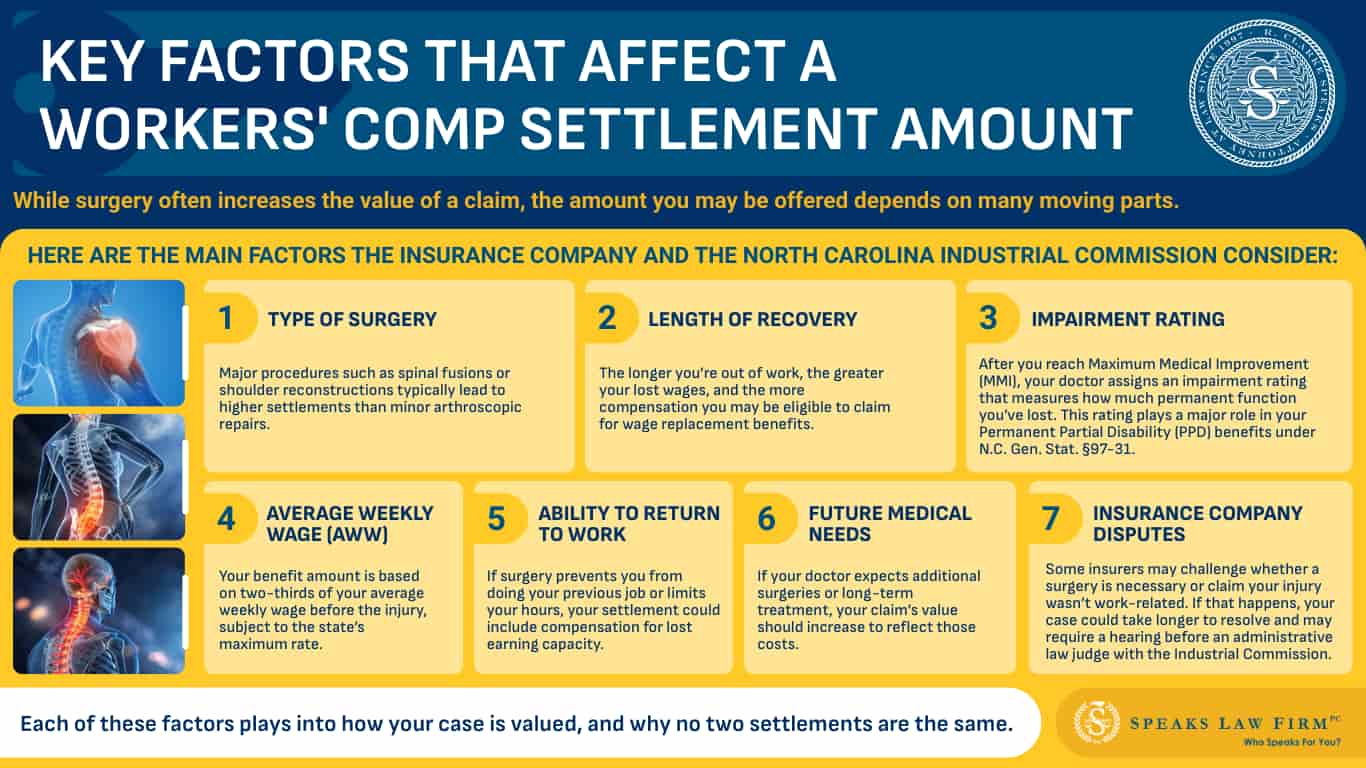
Several details can make a big difference in how much you receive through workers’ compensation. While surgery often increases the value of a claim, the amount you may be offered depends on many moving parts.
Here are the main factors the insurance company and the North Carolina Industrial Commission consider:
- Type of surgery. Major procedures such as spinal fusions or shoulder reconstructions typically lead to higher settlements than minor arthroscopic repairs.
- Length of recovery. The longer you’re out of work, the greater your lost wages, and the more compensation you may be eligible to claim for wage replacement benefits.
- Impairment rating. After you reach Maximum Medical Improvement (MMI), your doctor assigns an impairment rating that measures how much permanent function you’ve lost. This rating plays a major role in your Permanent Partial Disability (PPD) benefits underN.C. Gen. Stat. §97-31.
- Average weekly wage (AWW). Your benefit amount is based on two-thirds of your average weekly wage before the injury, subject to the state’s maximum rate.
- Ability to return to work. If surgery prevents you from doing your previous job or limits your hours, your settlement could include compensation for lost earning capacity.
- Future medical needs. If your doctor expects additional surgeries or long-term treatment, your claim’s value should increase to reflect those costs.
- Insurance company disputes. Some insurers may challenge whether a surgery is necessary or claim your injury wasn’t work-related. If that happens, your case could take longer to resolve and may require a hearing before an administrative law judge with the Industrial Commission.
Each of these factors plays into how your case is valued, and why no two settlements are the same.

The Role of Maximum Medical Improvement (MMI)
After surgery, you may want to put the whole process behind you and move on. That’s understandable. But settling your claim too early can leave you without the benefits you’ll need later.
Your doctor will eventually determine when you’ve reached Maximum Medical Improvement, often called MMI. This means your condition has stabilized, and further treatment is unlikely to make a major difference in your recovery. At that point, your doctor can evaluate whether you have any permanent limitations and assign an impairment rating.
This rating directly affects how much you can be eligible to receive for Permanent Partial Disability (PPD) benefits. Settling before you reach MMI could prevent you from being fairly compensated for lasting damage or future medical costs.
If you’re unsure whether you’ve reached MMI, talk to your treating physician and review your medical records. It’s important to have a clear picture of your long-term condition before closing your case.
How Settlements Are Calculated in North Carolina
In North Carolina, workers’ compensation settlements are based on several main components that reflect both your financial losses and your lasting physical limitations. Each part is defined under the North Carolina Workers’ Compensation Act and administered by the North Carolina Industrial Commission.
Here’s how the process generally works:
- Temporary Total Disability (TTD): If you cannot work at all while recovering from surgery, you can receive two-thirds of your average weekly wage until you can return. These benefits may continue for up to 500 weeks, depending on your condition.
- Temporary Partial Disability (TPD): If you return to work but earn less than before your injury, you can receive two-thirds of the difference between your old and new wages.
- Permanent Partial Disability (PPD): Once you reach Maximum Medical Improvement, your doctor assigns an impairment rating. Your compensation for permanent loss is then calculated based on that rating and the affected body part, as listed in N.C. Gen. Stat. §97-31.
- Medical care: Workers’ compensation pays for all reasonable and necessary medical treatment, including surgery, rehabilitation, and prescriptions.
- Vocational rehabilitation: If you cannot return to your old job, you may qualify for services that help you train for new employment.
- Future medical costs: When calculating a settlement, your doctor’s recommendations for ongoing treatment, physical therapy, or additional procedures are often factored into the total amount.
The goal of this process is to make sure injured employees can access compensation that reflects both their recovery needs and the long-term effects of their injury.
Mistakes That Can Lower Your Settlement
Even a strong workers’ compensation case can lose value if certain mistakes occur. Be aware of these common pitfalls:
- Failing to report the workplace injury promptly to your employer
- Not seeking immediate medical attention or skipping appointments
- Settling before reaching Maximum Medical Improvement
- Not getting a second opinion if you disagree with the employer’s doctor
- Ignoring restrictions from your healthcare provider
- Not keeping thorough medical records or documentation of your symptoms
- Trying to handle disputes directly with insurance adjusters instead of through legal counsel
Avoiding these mistakes can make a significant difference in your ability to seek fair compensation.
What to Expect from the Workers’ Compensation Process
The North Carolina workers’ compensation claims process follows several key steps:
- Report the injury: Notify your employer in writing within 30 days of the accident underN.C. Gen. Stat. §97-22.
- File a Form 18: Submit your claim to the North Carolina Industrial Commission.
- Medical treatment: See an approved healthcare provider and follow the treatment plan.
- Receive benefits: You may begin receiving temporary disability or medical benefits if approved.
- Reaching MMI: Once you stabilize, your doctor assigns an impairment rating.
- Settlement negotiation: You may agree to a lump-sum settlement (often called a “clincher”) or continue receiving weekly benefits.
- Dispute resolution: If disputes arise, a deputy administrative law judge may hear your case.
Each stage requires careful documentation and attention to deadlines to protect your rights.
When to Speak with a Charlotte Workers’ Compensation Lawyer

If your injury required surgery, your case likely involves significant medical expenses and long-term effects. Insurance companies often attempt to limit payouts or close cases quickly before the full impact of surgery is known. Having a workers’ compensation lawyer familiar with the North Carolina Industrial Commission process can make a major difference in how your case is handled.
A lawyer can:
- Review your medical records and calculate your average weekly wages
- Negotiate with the employer’s insurer for a fair settlement
- Represent you before an administrative law judge if your claim is denied
- Evaluate potential third-party claims
- Make sure all necessary forms and deadlines are met under state law

Protecting Your Well-Being After Surgery
Your health and recovery are the most important parts of your case. Focus on your medical treatment and following your doctor’s recommendations. If your employer fails to provide proper care or denies benefits, the law gives you the right to request a hearing before the North Carolina Industrial Commission.
Remember that workers’ compensation covers workplace injuries, occupational diseases, and even repetitive stress injuries such as carpal tunnel syndrome. Each case must be evaluated on its individual facts, medical evidence, and work history.
Talk to a Charlotte Workers’ Compensation Lawyer About Your Surgery Settlement
A workplace injury that leads to surgery can take a serious toll physically, financially, and emotionally. Between medical bills, missed paychecks, and pressure from the insurance company, it can feel like you’re carrying the burden alone. A settlement amount depends upon many factors, and the right way to estimate the value of your unique claim is to consult a North Carolina attorney experienced in Charlotte workplace injury cases.
At Speaks Law Firm, our Charlotte workmans’ comp attorneys stand up for injured employees throughout North Carolina. We understand how surgery changes everything about a claim, from medical costs to long-term recovery. Our team investigates every case carefully, challenges unfair insurance decisions, and looks for every possible source of compensation, including third-party claims when applicable.
If your injury occurred on the job and required surgery, contact our law offices for a FREE case review. Call (910) 341-7570(910) 341-7570 or fill out our confidential online form. We will review your case, answer your questions, and discuss your next steps with honesty and care.
While you wait for your FREE consultation, we invite you to check out our podcast, Personal Injury Lawyer Podcast with American Injury Lawyer Clarke Speaks.
Who Speaks for You? We Do!
Copyright © 2026. Speaks Law Firm. All Rights Reserved.
The information in this blog post (“post”) is provided for general informational purposes only and may not reflect the current law in your jurisdiction. No information in this post should be construed as legal advice from the individual author or the law firm, nor is it intended to be a substitute for legal counsel on any subject matter. No reader of this post should act or refrain from acting based on any information included in or accessible through this post without seeking the appropriate legal or other professional advice on the particular facts and circumstances at issue from a lawyer licensed in the recipient’s state, country, or other appropriate licensing jurisdiction.
Speaks Law Firm902 Market St. Wilmington, NC 28401(910) 341-7570https://www.speakslaw.com/