
A workplace injury in Charlotte can disrupt your income almost immediately. You may have been told to stay home, follow restrictions, or wait for approval before returning to work. While you’re managing the pain and keeping up with medical appointments, you’re also watching your regular paychecks stop without any workers’ comp payments arriving. Your employer might say the claim has been reported, and the insurance company may tell you it’s still reviewing your file, but that doesn’t change the reality that your bills are already due.
This is usually when people start searching online for “when does workers’ comp start paying” in North Carolina. You expected benefits to begin sooner, yet days or even a week or two have gone by without a clear update. No one explained the waiting period, how long the insurance company can take to make a decision, or what actually triggers the first payment. When your income stops and no one gives you a clear update, it can feel like everything has been left on your shoulders.
If you’re trying to figure out how long workers’ comp takes to start paying in Charlotte, the sections below outline the timeline under North Carolina law, what commonly causes delays, and what typically must happen before wage replacement begins.
How Workers’ Compensation Works in Charlotte
Workers’ compensation in North Carolina is meant to replace your income and cover medical care when a workplace accident keeps you off the job. Employers with three or more employees must carry workers’ compensation insurance, and most injured workers fall under that protection. Even so, the process doesn’t feel automatic when you’re the person waiting for checks to arrive.
After you report the injury and seek medical treatment, the insurance company reviews your claim to decide whether the injury is covered and whether you qualify for wage replacement. That decision controls when payments begin. While medical care is covered once the claim is accepted, wage replacement only starts after several legal steps are completed and after the waiting period under North Carolina law.
The benefits available in a Charlotte workers’ compensation claim can include medical treatment, lost wages, temporary or permanent disability payments, and, in the most serious cases, funeral and burial expenses for surviving family members. But the part most workers worry about first is when their income will resume, and that depends on how quickly the early steps of your claim are completed.

When Workers’ Comp Starts Paying in North Carolina
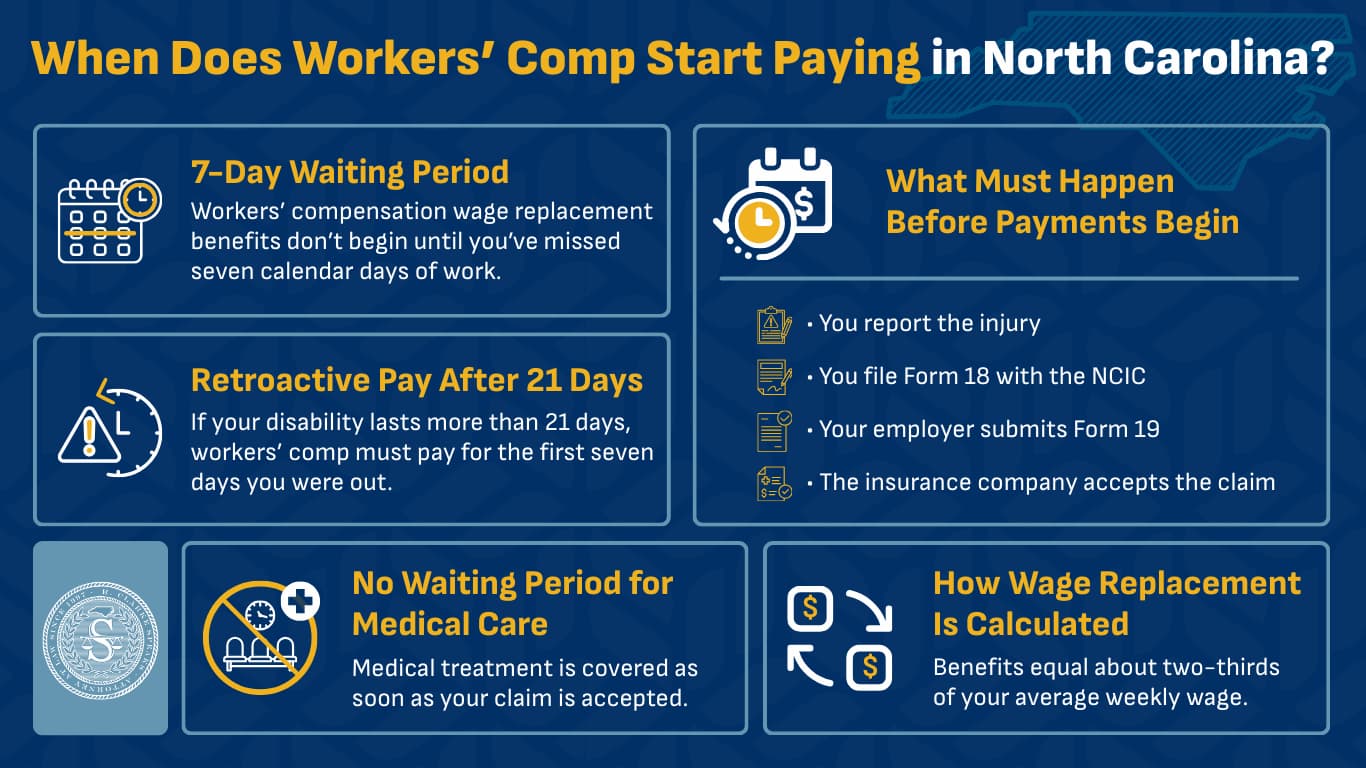
One of the first questions injured workers ask after missing several days of work is when wage replacement will begin. North Carolina law includes a mandatory seven calendar days’ waiting period before temporary total disability or temporary partial disability benefits apply. Many injured workers don’t hear about this rule until they’ve already gone without income, because employers aren’t required to explain the waiting period.
Here’s what the waiting period means for your paycheck:
- Missing seven days or less: wage replacement isn’t issued for that period
- Missing more than 21 days: workers’ comp must go back and pay for the first seven days you were out of work
This rule appears in the North Carolina Workers’ Compensation Act, which is administered through the North Carolina Industrial Commission.
Once the waiting period has passed and the insurance company accepts your claim, payments should begin shortly after. Checks are typically issued weekly and equal roughly two-thirds of your average weekly wage. For injuries occurring in 2026, North Carolina law caps this amount at $1,446.00 per week.
The insurance company calculates your rate using your earnings from the 52 weeks before the injury. It’s important to make sure they include all gross wages, including overtime pay and bonuses, as these can significantly increase your weekly check. If you worked for your employer for less than a year, North Carolina law provides alternate methods to reach a fair and accurate number.
Even though these steps look straightforward on paper, delays often happen because the insurance company is still reviewing medical records, waiting for employer forms, or confirming your work restrictions. When you’re depending on wage replacement to cover your household expenses, even a small delay can feel much larger.
What Must Happen Before Workers’ Comp Payments Begin
Even after the waiting period, wage replacement doesn’t start until several pieces are in place. This part catches many injured workers off guard, because no one explains how many steps must happen between the injury and the first check. When one part of the process slows down, the entire claim can feel stalled.
Here’s what needs to happen before payments begin:
1. You report the injury promptly
You’re expected to notify your employer in writing within 30 days of the accident. While you should tell your supervisor immediately, having a written record (like an email or a formal incident report) protects you if the insurance company later claims they weren’t notified on time.
2. You receive medical treatment and written restrictions
Workers’ comp pays wage replacement only when a doctor confirms that your injury keeps you from working or limits what you can safely do. If the medical note isn’t clear or hasn’t reached the insurance company yet, they may hold off on payments until they have that information.
3. Your employer submits required forms
Your employer must file Form 19 with the North Carolina Industrial Commission (NCIC). Some employers send it quickly. Others take longer than they should. Until this form is filed, the insurance company may not have what it needs to move forward.
4. You file your own claim with the NCIC
You must file Form 18 as your official notice of claim. Many workers aren’t told they need to complete it, which leads to denials or delays later. Without Form 18, the claim isn’t formally recognized by the state. Pro Tip: If you mail this form, send it via Certified Mail with a Return Receipt requested. Keeping a copy of the postal receipt prevents the insurance company from later claiming they never received your filing—a common issue that can derail a claim.
5. The insurance company accepts the claim
Payments begin only after the workers’ compensation carrier agrees that the injury is covered. If they say they’re still reviewing your medical records or waiting for more details from your employer, the first check may take longer than you expected.
These requirements help explain why the timeline can feel slow, even when you did everything right. When your income has already stopped, even small delays add pressure to an already difficult situation. That’s why many injured workers reach out to a Charlotte workers’ compensation attorney during this stage to understand whether the claim is moving as it should and what can be done if it isn’t.
When Medical Benefits Begin in a Workers’ Comp Claim

Medical treatment is usually the first part of a North Carolina workers’ compensation claim to move forward. There’s no waiting period for medical care, so once the injury is reported and the claim is accepted, the insurance company becomes responsible for treatment connected to the workplace accident.
What surprises many injured workers is how controlled this part of the process feels. Early on, the insurance company often directs you to a specific doctor or clinic. That choice may feel limiting, but it’s permitted under North Carolina law. As your claim progresses, there are ways to request different providers, but the first set of appointments is usually arranged through your employer or the insurance company.
Medical benefits can include:
- Office visits and follow-up appointments
- Diagnostic testing
- Surgery when recommended
- Prescription medications
- Physical therapy
- Rehabilitation
- Mileage reimbursement when travel qualifies
If your claim has been accepted and bills still show up at home, it usually means the provider billed the wrong insurance or the workers’ compensation carrier has not processed the charges yet. These situations happen often, and they are usually resolved once the billing office receives the correct information.
Your medical records during this time carry a lot of weight. They document your diagnosis, your restrictions, and your progress. They also influence wage replacement, work restrictions, and your return-to-work timeline. When treatment stalls or coverage is questioned, injured workers often contact a Charlotte workmans’ comp attorney so the issue doesn’t spread into other parts of the claim.

Why Some Claims Take Longer to Start Paying
Even when your claim seems straightforward, delays are common in North Carolina workers’ compensation cases. From the worker’s perspective, it often feels like everything has come to a standstill. But behind the scenes, several issues can slow the process. Knowing why these delays happen doesn’t make them easier to deal with, but it helps you recognize what may be happening in your claim.
Here are the most common reasons wage replacement takes longer than expected:
Incomplete or missing medical records
The insurance company can’t approve wage replacement without documentation showing your diagnosis and work restrictions. If records haven’t been sent, are missing details, or don’t clearly state your limitations, the adjuster may hold off on processing payments. This happens often when providers are backed up or when paperwork is routed through multiple offices.
Disputes about whether the injury occurred at work
If the insurance company questions how the accident happened or whether it ties back to your job duties, they may slow the decision. Even small discrepancies in early reports can cause the adjuster to request more information before accepting the claim.
Delays on the employer side
When an employer waits too long to submit required forms or fails to supply wage information, the insurance company doesn’t have what it needs to move forward. Many injured workers don’t realize that employer delays are one of the most common reasons checks don’t arrive on time.
Questions about pre-existing conditions
A prior injury doesn’t disqualify you from eligibility for benefits, but insurers sometimes use it as a reason to investigate longer. They may request additional records to determine what portion of your condition relates to the workplace accident.
Independent contractor classification issues
If your employer labeled you as an independent contractor, the insurance company may pause the claim until that status is reviewed. Misclassification is common across several industries and can complicate the start of wage replacement.
These situations don’t make your injury any less real, and they don’t lessen the financial pressure you’re facing while you wait. When delays continue with no clear answers, many injured workers speak with an attorney for worker comp to find out whether the timeline is normal or whether the insurance company is slowing the claim without a valid reason.
What Happens If the Insurance Company Denies Your Claim
A denial can feel overwhelming when you’ve already missed work and the bills are piling up. Many injured workers assume a denial means the end of the case, but North Carolina workers’ compensation law gives you a formal process to challenge that decision. The key is understanding what happens next and how the dispute moves through the Industrial Commission.
Here’s how a denied claim typically progresses:
1. You file a request for a hearing
This is done through Form 33. It notifies the NCIC that you disagree with the denial and want a hearing before a judge. Filing this form puts your dispute into the Commission’s system and moves the case forward.
2. Your case is scheduled for mediation
Mediation is required in most workers’ compensation cases. It gives both sides an opportunity to discuss the issues, review medical records, and consider possible resolution. Many disputes are resolved during mediation once the insurance company reviews the full picture.
3. A hearing takes place if the case doesn’t settle
If mediation doesn’t lead to agreement, an administrative law judge will hear the case. The judge reviews evidence, hears testimony, and issues a written decision. This stage can feel formal, but it’s designed to give injured workers a chance to present the facts of the accident and the medical evidence supporting the claim.
4. Appeals may follow
If either side disagrees with the judge’s decision, they can appeal to the Full Commission. Further appeals can go to the North Carolina Court of Appeals, but most disputes are resolved before reaching that level.
A denial doesn’t mean your injury is being dismissed. It usually means the insurance company wants more information or disagrees with some part of the claim, whether it’s about how the accident occurred, the medical documentation, or your work restrictions.
When a denial comes without a clear explanation or when the insurance company continues to question the claim, many injured workers reach out to a Charlotte workers’ compensation attorney to protect the case as it moves through the Industrial Commission.
How Long Workers’ Comp Benefits Last Once They Begin
Once wage replacement starts, most injured workers want to know how long the payments will continue. North Carolina workers’ compensation law doesn’t use a one-size timeline. The length of benefits depends on your medical condition, your restrictions, and whether you can safely return to work. Your doctor’s notes and treatment progress guide most of these decisions, and the insurance company uses that information to determine which category of benefits applies.
Here are the benefit types you may encounter as your claim moves forward:
Temporary Total Disability (TTD)
These payments continue while you’re completely out of work because of your restrictions. TTD lasts until your doctor releases you to return, or until you reach maximum medical improvement and your restrictions change. For many workers, this is the first type of wage replacement they receive.
Temporary Partial Disability (TPD)
If you’re able to return to work but earn less income because of your injury, TPD may apply. This benefit helps cover the gap between your pre-injury earnings and what you’re able to earn with restrictions. TPD can continue for up to 500 weeks under North Carolina law.
Permanent Partial Disability (PPD)
If your injury leaves you with a long-term limitation, your doctor may assign a permanent impairment rating. That rating determines whether PPD benefits apply and how long they last. These benefits are paid according to scheduled values in the Workers’ Compensation Act.
Permanent Total Disability (PTD)
PTD is reserved for the most severe injuries and cases involving catastrophic loss. Workers in this category may qualify for extended benefits when they cannot return to suitable employment.
Death Benefits
When a workplace accident leads to death, surviving dependents may qualify for weekly payments and coverage of funeral and burial expenses. These claims can be complex, and families often talk with an attorney to understand their rights.
The timeline for each benefit depends on your medical progress and how your restrictions change over time. Communication between your doctor and the insurance company plays a major role.
When to Consider Legal Guidance in a Workers’ Comp Case
Most workers start their claim hoping everything will move the way it should. But when checks don’t arrive, medical care stalls, or the insurance company raises questions that don’t match the facts of the accident, it’s reasonable to wonder whether you should speak with an attorney who routinely handles these cases. North Carolina workers’ compensation law outlines your rights, but for those rights to be upheld, the insurance company must follow the rules and processes of your claim correctly.
You may want to speak with a Charlotte workers’ compensation attorney when:
- The insurance company denies the claim or says it needs more time with no clear explanation
- Your doctor places you on restrictions that your employer cannot accommodate
- Wage replacement is delayed or calculated incorrectly
- Medical treatment is questioned or limited without a valid reason
- You’re asked to return to work before your doctor believes it’s safe
- The insurance company schedules an independent medical evaluation and you’re unsure what that means
- There are disputes about permanent disability ratings or your ability to return to suitable employment
These situations don’t mean you did anything wrong. They’re common issues that arise when multiple parties, such as the employer, the doctor, and the insurance company, control different parts of your claim. When your income, medical care, or long-term work status feels uncertain, many injured workers reach out for legal guidance to understand what should be happening and what steps can protect their case.
Talking with a workers’ comp attorney doesn’t create a formal attorney-client relationship by itself. It’s simply an opportunity to get feedback on what you’re dealing with and decide whether you want someone handling communication with the insurance company while you focus on healing.

Speak With a Charlotte Workers’ Compensation Attorney About Benefit Delays
When your income stops after a workplace injury and your workers’ compensation checks still haven’t started, it puts immediate strain on your routine and your household budget. You’re doing your part by following medical instructions and staying in contact with your employer, but you still need answers about what the insurance company is doing with your claim.
At Speaks Law Firm, our Charlotte workers’ compensation lawyers review delays, gather the information the insurance company relies on, and address problems that hold up wage replacement. Our team takes a close look at your medical records, your work restrictions, and the steps taken so far in your claim. If something isn’t moving the way it should, we explain why and what options you have going forward.
If you would like to discuss the delay in your claim, call [(910) 341-7570](tel:(910) 341-7570) or submit our confidential online form to schedule your FREE case review.
While you wait for your FREE consultation, we invite you to check out our podcast, Personal Injury Lawyer Podcast with American Injury Lawyer Clarke Speaks.
Who Speaks for You? We Do!
Copyright © 2026. Speaks Law Firm. All Rights Reserved.
The information in this blog post (“post”) is provided for general informational purposes only and may not reflect the current law in your jurisdiction. No information in this post should be construed as legal advice from the individual author or the law firm, nor is it intended to be a substitute for legal counsel on any subject matter. No reader of this post should act or refrain from acting based on any information included in or accessible through this post without seeking the appropriate legal or other professional advice on the particular facts and circumstances at issue from a lawyer licensed in the recipient’s state, country, or other appropriate licensing jurisdiction.
Speaks Law Firm902 Market St. Wilmington, NC 28401(910) 341-7570https://www.speakslaw.com/