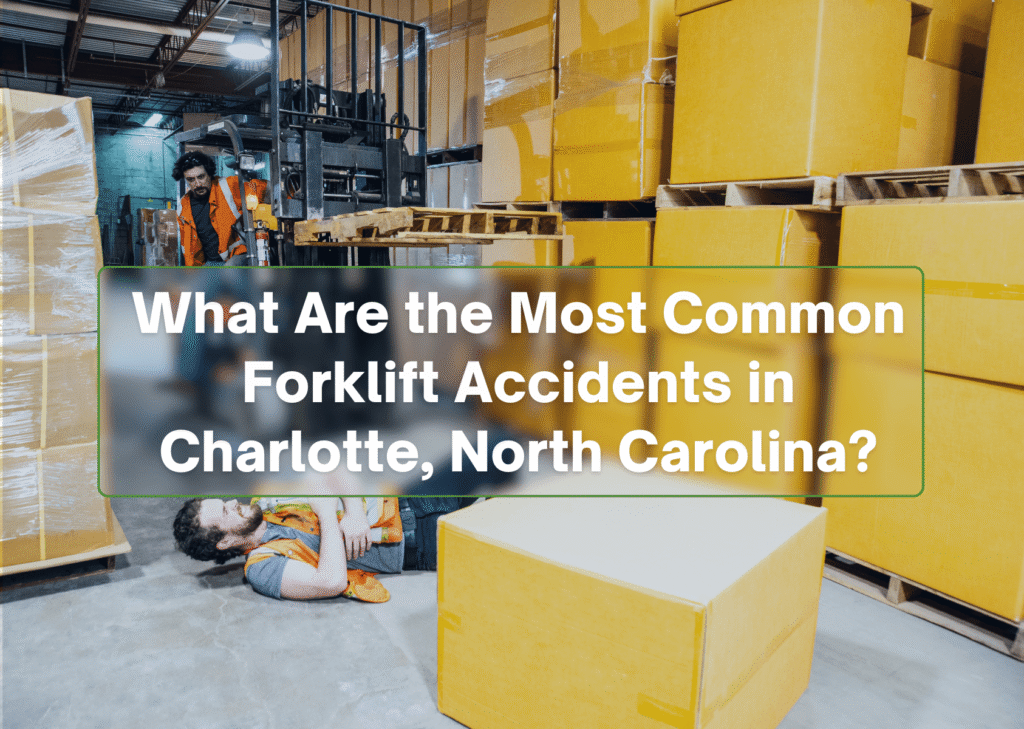
Forklifts are a familiar sight in Charlotte’s warehouses, construction sites, and loading docks. They move heavy loads quickly and make demanding work more manageable, but when something goes wrong the consequences can be immediate and severe.
Across North Carolina, forklift accidents continue to cause serious injuries in warehouses, factories, shipping yards, and distribution centers. These machines are part of everyday operations, yet the dangers they pose are significant.
Whether you have been injured in a forklift accident or want to stay alert to the risks in your workplace, it helps to know about the most common forklift accidents and why they happen. With that understanding, you can take steps to protect yourself and your coworkers while also being aware of your rights under North Carolina law.

Forklift Accident Risks in Charlotte and Across North Carolina
Forklifts contribute to thousands of injuries and dozens of deaths nationwide each year. More than 8,000 non-fatal injuries are reported annually, and nearly 80 workers lose their lives in these accidents (National Safety Council). Over a recent two-year span, forklift-related injuries exceeded 24,000, showing how common these incidents are.
In North Carolina, the warehousing and storage industry, where forklifts are used daily, lists struck-by accidents involving powered industrial trucks as one of the most frequent hazards, along with musculoskeletal disorders from repetitive work. With Charlotte’s role as a major hub for manufacturing and logistics, forklift accidents are not rare events but an ongoing workplace danger.
In the sections that follow, we’ll look at the accident types most often reported by North Carolina workers and why they remain a concern in Charlotte workplaces.
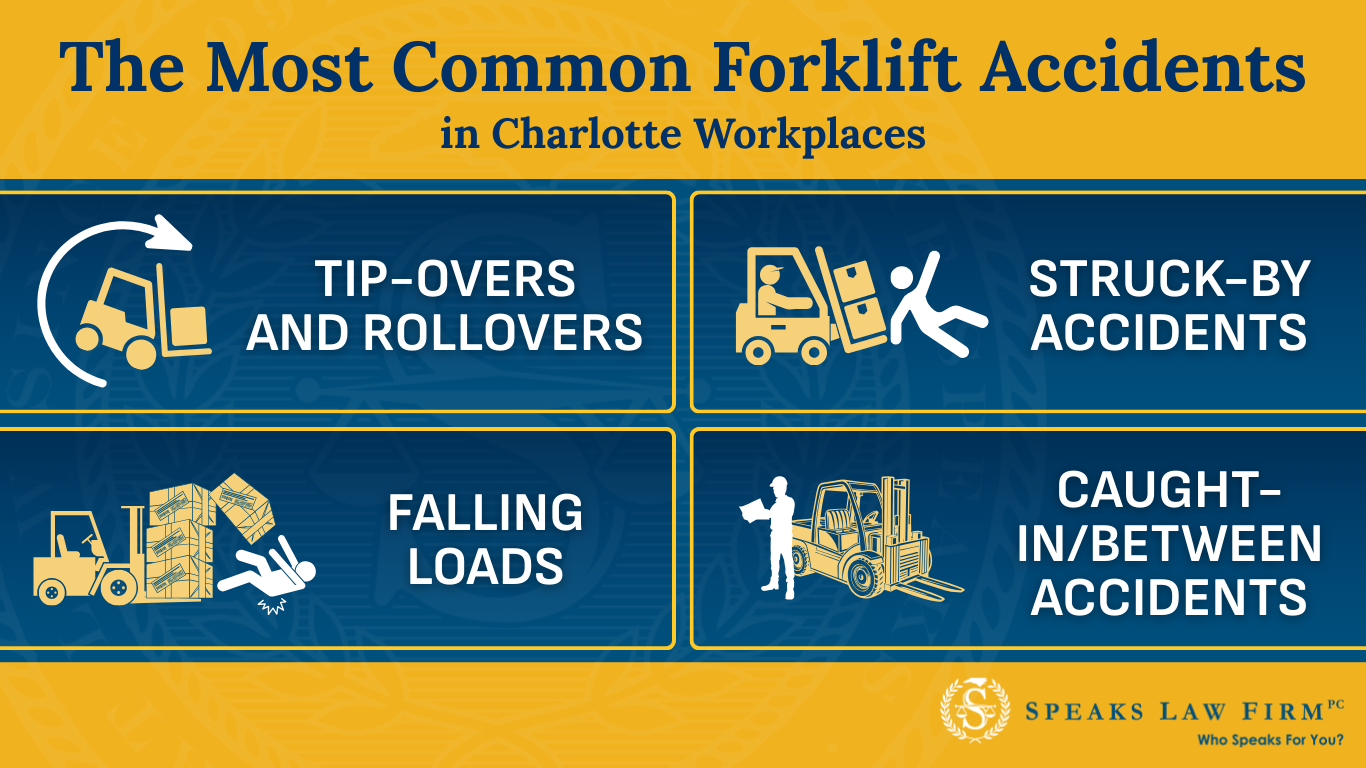
The Most Common Forklift Accidents in Charlotte Workplaces
Forklifts can cause injuries in a number of different ways, but some accidents occur more often than others in Charlotte workplaces.
Tip-Overs and Rollovers
Tip-overs are the single most dangerous type of forklift accident. They occur when the machine becomes unstable and falls onto its side or back, often trapping the operator or crushing nearby workers.
Common causes of tip-overs include:
- Loads that are too heavy or not evenly balanced
- Sharp turns or sudden stops at higher speeds
- Operating on inclines, ramps, or uneven flooring
- Raising the forks too high while moving
- Worn tires or poor equipment condition
In Charlotte’s large distribution centers and fast-moving shipping yards, operators often work under pressure to move goods quickly. That pressure makes overloaded forks or unsafe turns more likely. When a forklift weighing several tons tips, the injuries are often catastrophic, ranging from broken bones and crushed limbs to traumatic brain injuries and fatalities.
Struck-By Accidents
Struck-by accidents happen when a forklift collides with pedestrians, co-workers, or stationary objects. These incidents are common in loading docks, manufacturing plants, and warehouses with crowded aisles.
Factors that contribute to struck-by accidents include:
- Limited visibility when carrying large or high loads
- Operating in tight or congested spaces
- Taking turns too quickly
- Inattentive driving or distractions
- Lack of clear pedestrian walkways
In Charlotte’s warehousing and logistics hubs, struck-by accidents can happen in seconds. A single impact can lead to broken bones, internal injuries, or spinal cord damage. Even low-speed collisions are powerful enough to knock a worker down or pin them against shelving or machinery.
Falling Loads
When loads are not properly secured or exceed the forklift’s rated capacity, they can tumble off during transport. This puts anyone nearby at risk of being struck or crushed.
Why falling loads happen:
- Pallets stacked too high or unevenly
- Damaged or unstable packaging
- Moving with the forks raised too far
- Driving over bumps, potholes, or uneven flooring
- Rushing to meet tight deadlines and skipping safety checks
Charlotte’s warehouses often handle heavy shipments of building materials, machinery, or bulk consumer goods. If one of these loads falls, the weight can cause severe trauma, including crushed limbs, head injuries, and permanent disability.
Caught-In/Between Accidents
Caught-in or caught-between accidents occur when a worker becomes trapped between a forklift and another surface, such as a wall, shelving, or another vehicle. Operators themselves may also be pinned if the forklift tips while they’re not wearing proper restraints.
Scenarios where this happens:
- Reversing into tight spaces without a spotter
- Parking too close to walls or barriers
- Operating near other heavy equipment or vehicles
- Workers standing too close to the machine during operation
These accidents are often devastating, causing crushing injuries to the torso or lower body. In many cases, they lead to permanent disability or death. In Charlotte workplaces with narrow aisles and high storage racks, the risk of caught-in/between accidents is particularly high.
Other Forklift-Related Injuries and Risks
Not every forklift-related injury comes from a dramatic accident. Some develop over time or occur because of conditions surrounding the equipment. These include:
- Repetitive Stress Injuries: Long hours of operating forklift controls can lead to carpal tunnel syndrome, tendinitis, or chronic back and neck pain. While not sudden accidents, these injuries affect many long-term operators.
- Maintenance-Related Accidents: Faulty brakes, hydraulic failures, or worn tires can cause collisions, tip-overs, or dropped loads. When forklifts aren’t regularly inspected or serviced, the likelihood of accidents increases.
- Inadequate Training or Supervision: Operators who haven’t been properly trained are more likely to overload forklifts, drive unsafely, or miss warning signs of instability. Lack of supervision in high-traffic Charlotte warehouses adds to the danger.
These risks are just as real as the more dramatic accidents and are part of why forklift safety remains a constant challenge in Charlotte workplaces.
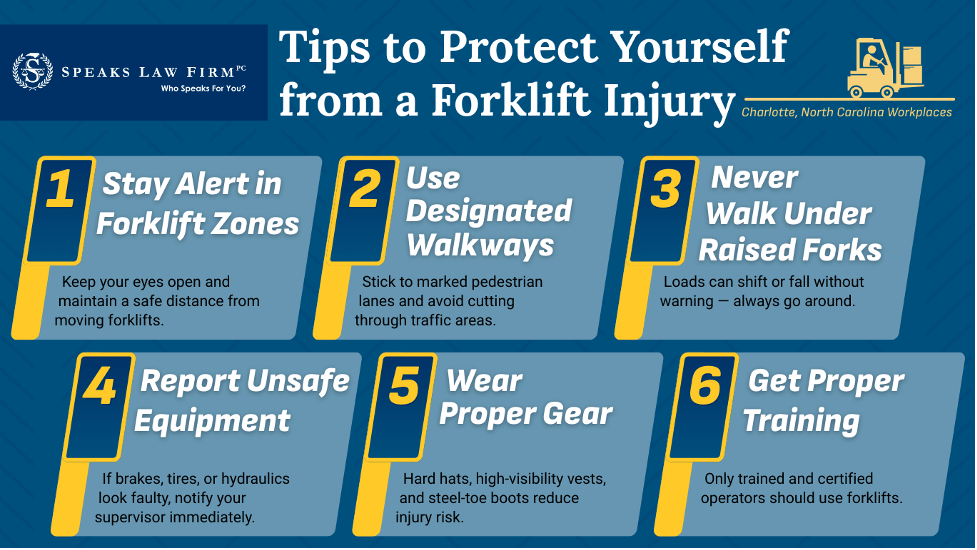
Along with knowing the most common accidents, it’s worth keeping these simple safety tips in mind to reduce risk on the job.
The Impact of Forklift Accidents in Charlotte Workplaces
The damage from a forklift accident doesn’t end with the immediate injury. These incidents often leave lasting effects that ripple through every part of your life. In Charlotte’s warehouses, loading docks, and factories, workers who suffer forklift accidents frequently face challenges such as:
- Medical treatment and recovery needs: Injuries from tip-overs, struck-by incidents, or falling loads often require hospitalization, surgery, or ongoing therapy.
- Time away from work: Even short-term injuries can keep you off the job, while more serious ones may affect your ability to return at all.
- Financial strain: Lost income combined with medical expenses can create long-term pressure on you and your family.
- Insurance company disputes: Adjusters may argue the injury wasn’t work-related or try to minimize the cost of benefits.
- Additional claims in some cases: If faulty equipment or a third party was involved, you may have legal options beyond workers’ compensation.
Forklift accidents affect far more than the moment of impact. Understand the broader consequences, which set the stage for why North Carolina law provides different types of workers’ compensation benefits to injured employees.
What Workers’ Compensation Covers in Forklift Accidents
If your injury happened while using or working near a forklift in Charlotte, you may be eligible to receive workers’ compensation benefits under North Carolina law. These benefits are designed to cover the costs of medical care and provide income support while you recover.
Workers’ compensation in North Carolina provides:
- Medical treatment for the work injury, including hospital stays, surgery, physical therapy, and prescriptions, as long as it is reasonably required to cure or relieve the effects of the injury (NCIC Form 28B).
- Wage replacement equal to two-thirds of your average weekly wages if you are unable to work, payable after the seven-day waiting period.
- Temporary partial disability benefits if you can return to work in a reduced capacity and earn less than before.
- Permanent partial disability benefits when an injury leaves lasting impairment or limits your future earning capacity.
- Permanent total disability benefits if the injury leads to total, lifelong disability, with ongoing medical coverage included (N.C. Gen. Stat. § 97-29).
- Death benefits and funeral expenses for surviving family members if a worker dies as a result of a work-related accident (NCIC Form 29).
Since workers’ compensation in North Carolina is a no-fault system, you do not have to prove that your employer acted negligently. As long as the injury is work-related, you have the right to file a claim and seek these benefits.
Knowing what benefits are available is only part of the picture. To actually be eligible to receive them, you’ll need to follow the North Carolina workers’ compensation process.
The Workers’ Compensation Process in North Carolina
After a forklift accident in Charlotte, access to benefits is not automatic. North Carolina law requires injured employees to follow certain steps to start and maintain a workers’ compensation claim. Missing deadlines or failing to follow procedure can put your benefits at risk.
Key steps in the process include:
- Reporting the accident to your employer right away. North Carolina law requires written notice within 30 days of the injury.
- Filing the official claim with the North Carolina Industrial Commission. This is typically done using Form 18, which notifies both your employer and the Commission.
- Receiving medical treatment. Your employer has the right to direct initial care, but you may request a second opinion if needed.
- Monitoring your claim. The insurance company will review medical records, accident reports, and wage information to determine eligibility and benefit amounts.
At each stage, disputes can arise. Insurance adjusters may argue the injury is not work-related, that your medical care is unnecessary, or that your wage calculation is too high. A Charlotte workers’ compensation lawyer can step in if your claim is delayed or challenged, making sure the process stays on track.

When a Workers’ Comp Claim Is Denied
Even if you follow the process, some forklift accident claims are denied by the insurance company. A denial can be frustrating, but it does not mean the end of your case.
Common reasons for denial include:
- The insurance company claims the injury did not happen at work
- The accident is blamed on alleged employee misconduct
- The injury is labeled as a pre-existing condition
- Deadlines for reporting or filing were missed
If your claim is denied, you have the right to request a hearing before an administrative law judge with the North Carolina Industrial Commission. At this stage, most cases are automatically referred to mediation, where both sides meet with a neutral mediator to try to resolve the dispute before it reaches a formal hearing.
Mediation is designed to encourage settlement, but if no agreement is reached, your case proceeds to a hearing where the judge reviews medical records, accident reports, and testimony before making a decision.
While many disputes are resolved through mediation or hearings, some forklift accidents involve factors outside the workers’ compensation system. In those cases, you may also have the option of filing a personal injury claim.
Can You File a Personal Injury Claim Too?
Workers’ compensation prevents lawsuits against your employer. But certain forklift accidents involve third parties or outside factors that open the door to a personal injury claim. This may apply if:
- A subcontractor, vendor, or other outside worker caused the accident
- The forklift or its parts were defective
- A delivery driver struck you while inventory was being moved
Unlike a workers’ compensation claim, a personal injury claim can include compensation for pain and suffering, emotional distress, and the full amount of lost wages. These cases often run alongside a workers’ compensation claim but require a different legal approach.
How to Strengthen Your Workers’ Compensation Case
The strength of your claim often depends on what you do immediately after the accident and in the weeks that follow. Taking the right steps can make it harder for the insurance company to dispute your benefits.
Key actions after a forklift accident include:
- Report the accident right away. North Carolina law requires you to give written notice within 30 days, even if you think the injury is minor.
- Get medical treatment promptly. Your employer may choose the initial provider, but you can request a second opinion or see your own doctor if needed.
- Keep detailed records. Document your symptoms, treatments, and how the injury affects your daily life.
- Track your finances. Save proof of lost wages and any out-of-pocket medical expenses.
- Be cautious with insurance adjusters. They may pressure you to return to work too soon or accept less than you should.
- Understand maximum medical improvement (MMI). This is the stage when your condition has stabilized. If you reach MMI but still have limitations, you may be evaluated for permanent disability benefits.

Employer Responsibilities for Forklift Safety in North Carolina
Employers in Charlotte and across North Carolina are legally required to provide a safe workplace. When it comes to forklifts, this means following both federal Occupational Safety and Health Administration (OSHA) standards and regulations enforced by the North Carolina Department of Labor. These rules are designed to reduce the risk of serious accidents, yet violations remain common in warehouse and industrial settings.
Key employer responsibilities include:
- Proper training and certification. Operators must receive training that covers forklift operation, load handling, and workplace hazards. Refresher training is required if unsafe practices are observed or if the equipment changes.
- Equipment inspections and maintenance. Forklifts must be regularly inspected and removed from service if safety issues such as faulty brakes, hydraulic leaks, or worn tires are identified.
- Safe workplace design. Employers should separate forklift traffic from pedestrian areas, maintain clear aisles, and provide adequate lighting.
- Hazard communication. Workers should be warned about areas where forklifts operate, and they should be instructed on how to move safely around them.
When employers cut corners, such as failing to train workers, ignoring maintenance schedules, or allowing overcrowded aisles, the risk of accidents increases. These failures don’t excuse unsafe operation, but they do show how preventable many forklift incidents really are.
Forklift Accidents and OSHA Investigations
Forklift accidents that result in serious injury or death often trigger investigations by OSHA. In North Carolina, OSHA enforcement is handled through the state’s approved plan under the Department of Labor.
What to know about OSHA investigations:
- Focus on employer safety practices. OSHA looks at whether the employer followed forklift safety standards, including operator training, maintenance, and hazard prevention.
- Citations and penalties. If violations are found, employers can face fines and corrective orders. Repeat or willful violations carry heavier penalties.
- Separate from workers’ compensation. OSHA penalties do not provide financial recovery to injured workers. Workers’ compensation remains the system that covers medical treatment, lost wages, and disability benefits.
- Public records. OSHA citations are part of the public record, which can shed light on whether a workplace has a history of safety violations.
For Charlotte workers, this means a forklift accident may not only affect your health and livelihood, but it can also expose broader safety issues at your workplace. While OSHA penalties hold employers accountable, they do not provide compensation to injured workers. That is where workers’ compensation and legal guidance come in.
Injured in a Forklift Accident on the Job in Charlotte? We Can Help
Forklift accidents leave many Charlotte workers facing painful injuries, missed paychecks, and an uncertain future. Workers’ compensation can provide medical coverage, wage replacement, and disability benefits, but the process is rarely straightforward. Insurance companies may dispute your claim, delay your care, or try to minimize the impact of your injuries.
At Speaks Law Firm, we stand up for injured workers across Charlotte and throughout North Carolina. Our team understands both the challenges of the workers’ compensation system and the safety issues that often contribute to forklift accidents. If you’ve been searching for an “attorney for worker comp” or “worker comp lawyer near me,” our Charlotte team is ready to review your case, explain how North Carolina law applies, and represent you if your benefits are delayed, denied, or undervalued.
Call (910) 341-7570(910) 341-7570 or complete our confidential online form to schedule your FREE case review. You will not pay any upfront fees. We will also evaluate whether a personal injury claim may apply based on the circumstances of your forklift accident.
While you wait, we invite you to check out our podcast, The Verdict with American Catastrophic Injury Lawyer Clarke Speaks.
Who speaks for you in Charlotte? We do!
Copyright © 2026. Speaks Law Firm. All Rights Reserved.
The information in this blog post (“post”) is provided for general informational purposes only and may not reflect the current law in your jurisdiction. No information in this post should be construed as legal advice from the individual author or the law firm, nor is it intended to be a substitute for legal counsel on any subject matter. No reader of this post should act or refrain from acting based on any information included in or accessible through this post without seeking the appropriate legal or other professional advice on the particular facts and circumstances at issue from a lawyer licensed in the recipient’s state, country, or other appropriate licensing jurisdiction.
Speaks Law Firm902 Market St. Wilmington, NC 28401(910) 341-7570https://www.speakslaw.com/