Some personal injury lawsuits capture national attention. They expose corporate misconduct, reveal dangerous product defects, and lead to verdicts that reshape industries. Others quietly move through the legal system without media coverage but still change lives.
If you’re dealing with injuries in Wilmington or anywhere in North Carolina, your personal injury claim may never become front-page news. Still, the same legal principles apply whether a case involves billions of dollars or a single serious accident.
Understanding how major personal injury cases unfolded can help you better understand your own legal rights under North Carolina law. Each of these cases illustrates how evidence, accountability, and trial strategy can shape the outcome of a claim.
Before looking at those well-known cases, it helps to start with a basic question: what exactly is a personal injury lawsuit?
At a Glance
- A personal injury lawsuit is filed after someone is injured due to another party’s negligence.
- High-profile cases often reveal the same legal principles that apply to everyday injury claims.
- In North Carolina, contributory negligence rules can bar recovery if you are even 1% at fault.
- Most personal injury lawsuits must be filed within three years, while wrongful death claims generally carry a two-year deadline.
- Potential compensation may include medical expenses, lost income, and other economic and non-economic losses.
What Are Personal Injury Lawsuits?
A personal injury lawsuit is filed after someone is injured due to another party’s negligence. Under North Carolina law, injured individuals may seek financial compensation through a personal injury claim.
Personal injury cases commonly involve:
- Car accident collisions
- Motorcycle accidents
- Pedestrian accidents
- Dog bites
- Nursing home negligence
- Premises liability incidents
- Federal tort claims
- Wrongful death lawsuits
A successful personal injury lawsuit typically requires proof of:
- A duty of care
- A breach of that duty
- Causation
- Damages
In practical terms, this means showing that another party failed to act reasonably and that failure directly caused measurable harm. Damages can include medical expenses, lost wages, physical pain, emotional distress, property damage, and in wrongful death cases, funeral expenses.
These same elements appear in both everyday injury claims and the high-profile lawsuits that make national news. Now let’s examine five landmark cases that made the headlines.

1. Liebeck v. McDonald’s Restaurants
Often reduced to a punchline, Liebeck v. McDonald’s Restaurants was in fact a serious product liability case grounded in evidence of corporate knowledge and consumer safety concerns.
In 1992, Stella Liebeck, a 79-year-old woman, spilled McDonald’s coffee into her lap while seated in a parked vehicle. The coffee had been served at temperatures between 180 and 190 degrees Fahrenheit, hot enough to cause third-degree burns within seconds.
Liebeck suffered:
- Third-degree burns over approximately six percent of her body
- Severe burns to her inner thighs, groin, and buttocks
- The need for skin grafts
- Weeks of hospitalization
What is often overlooked is that she did not initially seek a large verdict. She asked only for reimbursement of her medical expenses. When settlement negotiations failed, litigation followed.
During the trial, evidence showed McDonald’s had received more than 700 prior burn complaints. Internal materials reflected awareness that the temperature posed a serious burn risk, yet policies remained unchanged.
The jury concluded McDonald’s breached its duty of care. The verdict included compensatory damages and a significant punitive damages award designed to deter similar conduct.
This case highlighted several important principles:
- Businesses owe a duty of care to consumers
- Corporate knowledge of prior injuries can establish negligence
- Punitive damages may be appropriate when conduct shows conscious disregard for safety
At its core, the case was about accountability. When a company knows of a risk and chooses not to address it, the civil justice system allows injured individuals to demand responsibility.
For North Carolina personal injury claims, the same principles apply.
2. Anderson v. Pacific Gas & Electric
Anderson v. Pacific Gas & Electric (PG&E) became one of the most well-known toxic exposure cases in American history. The litigation arose from groundwater contamination in Hinkley, California, where PG&E allegedly discharged hexavalent chromium into local water supplies for years.
Residents began noticing troubling patterns: unexplained illnesses, cancer diagnoses, and chronic medical conditions affecting multiple families. Unlike a single-event car accident, this case involved injuries that developed slowly over time.
Plaintiffs alleged PG&E:
- Contaminated groundwater
- Failed to warn residents
- Delayed remediation efforts
Proving causation required environmental testing, toxicology experts, medical experts, and extensive document discovery. Scientific evidence became central to the case.
Ultimately, the litigation led to a settlement exceeding $300 million.
The litigation showed how personal injury law addresses harm that may not be immediately visible. It also demonstrates how difficult corporate defendants often challenge causation, forcing injured families to build detailed medical and environmental records.
The litigation reinforced:
- Corporations have a duty to prevent foreseeable environmental harm
- Failure to warn can establish liability
- Complex injury cases often require expert testimony
For North Carolina personal injury claims, the burden remains the same: show duty, breach, causation, and damages. Even when harm develops gradually, the law provides a path forward.
3. Grimshaw v. Ford Motor Company

Grimshaw v. Ford Motor Company is one of the most significant product liability and personal injury lawsuits in American legal history. The Ford Pinto’s fuel tank design made it vulnerable during moderate-speed rear impacts. When struck, the tank could rupture and ignite.
In one such collision, a passenger was killed. Richard Grimshaw survived but suffered severe, permanent burn injuries.
During the trial, internal memoranda revealed Ford had analyzed the cost of redesigning the fuel tank against the projected cost of future injury claims. That cost-benefit calculation became central evidence.
The jury found Ford acted with conscious disregard for consumer safety. The verdict included compensatory damages and substantial punitive damages. Beyond the numbers, the case shifted public conversation. It emphasized that manufacturers must prioritize safety over profit calculations.
The verdict reinforced several key product liability principles:
- Manufacturers must design reasonably safe products
- Internal corporate documents can establish knowledge of danger
- Punitive damages may be awarded when conduct is reckless
For North Carolina personal injury victims, the lesson is clear: when evidence shows a preventable design risk tied to serious injury, accountability may follow.
4. The Deepwater Horizon Litigation
The Deepwater Horizon explosion in April 2010 became one of the largest and most complex personal injury cases in American history.
Eleven workers lost their lives. Many others suffered serious burns and traumatic injuries. Families faced sudden loss, financial uncertainty, and years of legal proceedings.
Claims were filed under maritime law, federal safety regulations, negligence principles, and federal laws governing offshore oil spills. These lawsuits included wrongful death, personal injury, and economic loss claims brought by workers, families, and businesses affected by the disaster. Injured workers and families alleged BP, the oil company responsible for the drilling operation, along with other contractors and rig operators:
- Failed to maintain safe drilling operations
- Ignored warning signs
- Violated safety standards
Litigation required engineering experts, safety compliance reviews, and extensive discovery across multiple corporate entities.
BP ultimately agreed to pay tens of billions of dollars in settlements and penalties. This case demonstrates that large-scale workplace disasters can involve overlapping layers of responsibility. When safety systems fail, injured workers and families have legal recourse.
It reinforced:
- Employers and corporations must maintain safe working conditions
- Violations of safety regulations can establish negligence
- Coordinated litigation may be necessary in catastrophic events
Although most North Carolina cases are not this large, the legal principles are the same.
5. Johnson & Johnson Talcum Powder Litigation
The Johnson & Johnson talcum powder litigation became one of the most significant product liability and personal injury cases in modern history.
Thousands of plaintiffs alleged long-term use of talc-based products caused ovarian cancer. Central to the claims were allegations that the company knew of potential asbestos contamination and failed to warn consumers.
Internal documents and scientific studies became focal points during trial proceedings. Several juries awarded substantial compensatory and punitive damages. The litigation raised broader questions about product safety testing, corporate transparency, and consumer trust.
Johnson & Johnson later attempted to resolve claims through a bankruptcy strategy involving a subsidiary entity. Courts have continued to scrutinize that approach. As of early 2026, the litigation remains ongoing.
The litigation underscores how product liability law evolves over time. When allegations involve long-term exposure and delayed injury, litigation can span years and shape national legal standards.
For individuals harmed by defective or dangerous products, personal injury law provides a framework to pursue financial compensation and demand accountability.

What These Cases Reveal About Personal Injury Law in Practice
Despite different facts, these famous personal injury lawsuits share common elements:
- Evidence is critical. In every case above, the outcome turned on documented proof, such as internal memos, scientific testing, prior complaint records, and corporate communications. Building a strong evidentiary record is the foundation of any successful claim.
- Corporations and insurance companies defend aggressively. From McDonald’s disputing burn severity to Ford challenging punitive damages on appeal, defendants rarely accept liability without a fight. Experienced representation helps counter well-funded defense strategies.
- Settlement negotiations often occur alongside trial preparation. Most of these cases were resolved through settlement, but only after extensive litigation. Attorneys who prepare every case for trial tend to negotiate from a stronger position.
- Financial compensation reflects the extent of harm. Verdicts and settlements in these cases were driven by the severity of injuries, the duration of suffering, and the degree of corporate misconduct. The same principle applies in North Carolina injury cases, even when the numbers are smaller.
- Trial lawyers influence resolutions. Skilled advocacy, knowing how to present evidence, examine witnesses, and frame arguments for a jury, made a measurable difference in each of these landmark cases.
Now let’s bring this closer to home.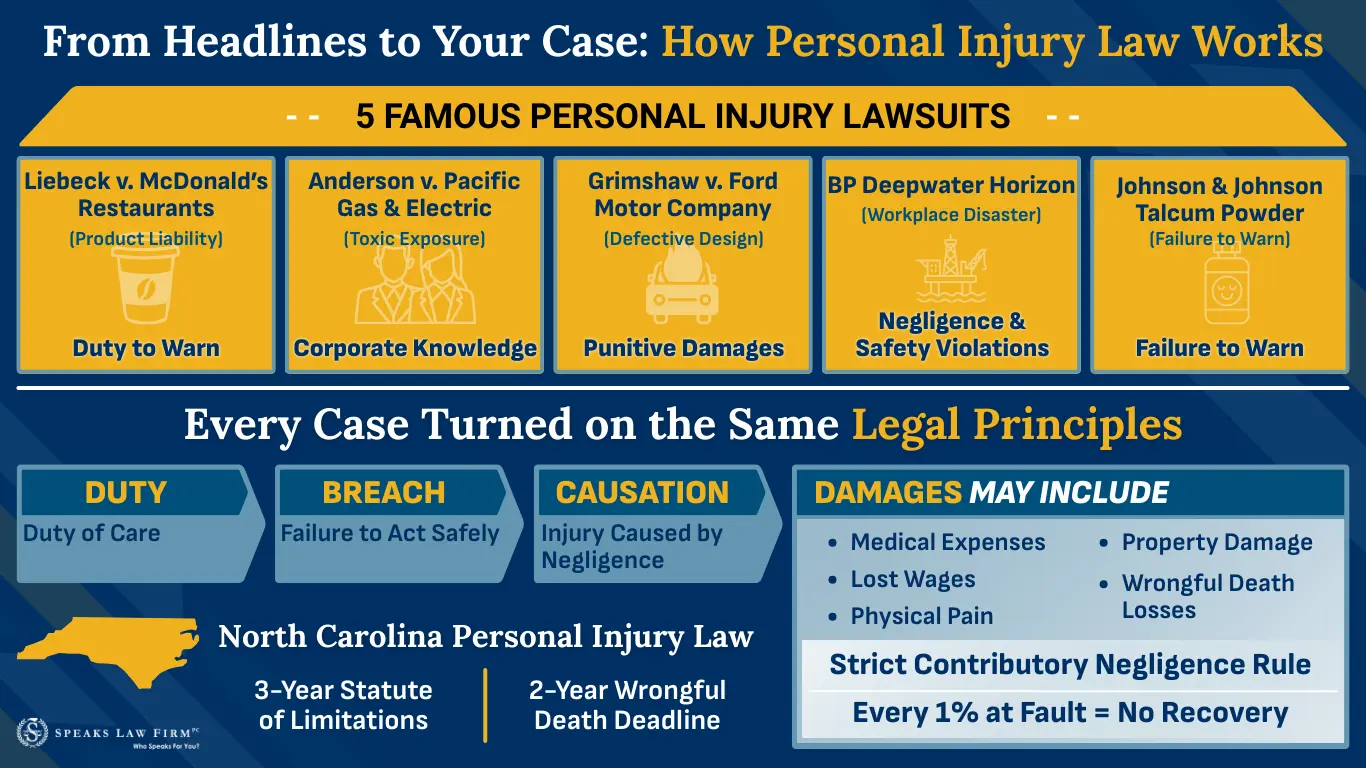
Your Personal Injury Case in North Carolina
In Wilmington and across North Carolina, most personal injury cases involve car accident injuries, motorcycle accidents, dog bites, medical malpractice, or work-related injury situations.
Even a single serious accident can lead to:
- Significant medical bills
- Ongoing medical expenses
- Lost wages
- Physical pain
- Emotional distress
- Unexpected costs
- Property damage
Major insurance companies begin investigating immediately. Their goal is often to reduce payouts. North Carolina law adds another layer of complexity.
Contributory Negligence in North Carolina
North Carolina follows the doctrine of contributory negligence. If you are found even one percent responsible for the accident, you may be barred from recovering compensation.
This contributory negligence rule under North Carolina law makes legal representation especially important. Experienced Wilmington injury lawyers can gather evidence, challenge fault allegations, and protect your legal rights.
How Personal Injury Lawsuits Work in North Carolina

Most personal injury lawsuits in North Carolina must be filed within three years. Wrongful death claims generally must be filed within two years.
A NC injury lawyer will typically:
- Gather evidence
- Review the accident report
- Collect insurance information
- Evaluate insurance coverage
- Engage in settlement negotiations
- Prepare for trial if necessary
Though many personal injury cases resolve through settlement, injury attorneys with a long track record of trial experience often negotiate from a stronger position.
What Compensation Can You Recover?
Depending on the facts of your case, you may be eligible to recover compensation for:
- Medical expenses
- Lost wages
- Reduced earning capacity
- Physical pain
- Emotional distress
- Property damage
- Funeral expenses in wrongful death cases
Your attorney will seek to recover the maximum compensation permitted under North Carolina law.
What to Look for When Choosing the Right Law Firm
When searching for Wilmington personal injury lawyers, look for:
- A personal injury law firm with a long track record
- Experienced personal injury attorneys
- Trial lawyers prepared to litigate
- A legal team that provides personal attention
- A contingency fee structure that allows you to pursue your case without paying upfront legal fees
At Speaks Law Firm, our personal injury attorneys work on a contingency basis. That means you pay no upfront fees and no upfront costs. Attorney fees are paid only if compensation is recovered on your behalf. This allows accident victims to pursue justice without risking their bank account.
Before you move forward, you may still have questions about how personal injury lawsuits work in North Carolina. The answers below address some of the most common concerns we hear from clients.

Were You Injured Because of Someone Else’s Negligence?
The famous personal injury lawsuits discussed above involved national corporations and massive verdicts. Most injury cases in North Carolina are not headline news, but they are life-changing for the people involved. Medical bills accumulate. Lost wages strain your household. Insurance companies begin protecting their financial interests immediately.
Speaks Law Firm represents individuals and families across North Carolina who have been harmed by negligent drivers, unsafe property conditions, defective products, medical malpractice, workplace incidents, and other serious accidents. When you speak with our team, you receive guidance grounded in years of handling complex injury cases under North Carolina law.
Our North Carolina personal injury attorneys understand how contributory negligence rules can affect your case. We investigate thoroughly, gather evidence, analyze insurance coverage, and prepare each matter with trial strategy in mind. Whether your claim involves a car accident, wrongful death, nursing home negligence, or another serious injury, our legal team works to pursue the maximum compensation permitted by law.
Many people begin their search online for “personal injury law attorneys near me” because they want experienced advocates who understand both the legal system and the insurance tactics used against accident victims. If that search brought you here, we invite you to learn how our firm approaches personal injury litigation.
If you would like to discuss your case, call (980) 291-6656(980) 291-6656 to schedule your FREE case review. If more convenient, you may also submit our confidential online form.
While you wait for your FREE consultation, we invite you to check out our podcast, Personal Injury Lawyer Podcast with American Injury Lawyer Clarke Speaks.
Who Speaks for You? We Do!
Copyright © 2026. Speaks Law Firm. All Rights Reserved.
The information in this blog post (“post”) is provided for general informational purposes only and may not reflect the current law in your jurisdiction. No information in this post should be construed as legal advice from the individual author or the law firm, nor is it intended to be a substitute for legal counsel on any subject matter. No reader of this post should act or refrain from acting based on any information included in or accessible through this post without seeking the appropriate legal or other professional advice on the particular facts and circumstances at issue from a lawyer licensed in the recipient’s state, country, or other appropriate licensing jurisdiction.
Speaks Law Firm902 Market St. Wilmington, NC 28401(910) 341-7570https://www.speakslaw.com/