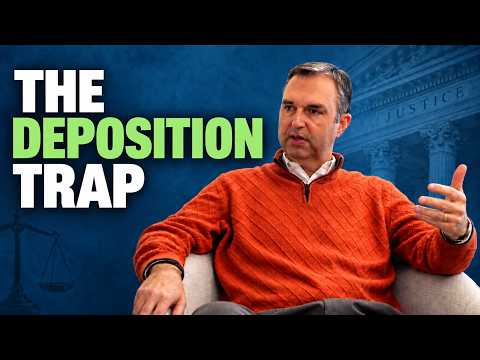
You got hurt at work, but does that mean you automatically have a workers’ comp case? Not so fast. In this episode of The Verdict, workers’ compensation lawyer Brian Groesser joins Clarke to provide clarity into one of the most misunderstood areas of workers’ compensation: what legally qualifies as an “accident.”
This video will help explain the difference between an injury and an accident, why not all workplace injuries are compensable, and how one key factor—an “interruption in the work routine”—can make or break your claim. You’ll hear real examples involving torn rotator cuffs, back injuries, and hernias, along with how specific details (like lifting something alone or encountering something heavier than expected) can determine whether your case gets denied or paid.
If you’ve ever assumed “I got hurt at work, so it’s covered,” this episode is your guide to how the system really works.
Here’s what we discuss in this episode: ⚠️ Not all workplace injuries are workers’ comp cases 🧠 Back injuries are treated differently under NC law 🏥 Specific examples: rotator cuff, hernias, heavy lifting 👨⚖️ Early legal help can mean the difference between denial and approval
0:00 – What makes an accident a workers’ comp case? 2:41 – Most common workers’ comp injury 4:46 – The role of the attorney
Featured Keyword & Other Tags
Workers comp, catastrophic injury, insurance claims, first 90 days, attorney
Client Links
Learn more about how Speaks Law Firm can help you: https://www.speakslaw.com/
Schedule your FREE case review: https://www.speakslaw.com/attorneys/r-clarke-speaks/#contactFormTarget
Find us on YouTube: https://bit.ly/3R40YMP
TranscriptClick to read
SPEAKERS
Brian Groesser, Clarke Speaks
Clarke Speaks 00:00
I’m Clark speaks, the catastrophic injury lawyer. Welcome to the verdict. Welcome to the verdict. I’m Clark speaks. This is Brian. Grocer, Brian, when you’ve talked in the first episode, you talked about workplace accidents, and you talked about that they must be in the scope of employment. Can you elaborate? Can you tell us more about workplace accidents that are covered under workers’
Brian Groesser 00:20
compensation? Sure, one of the biggest misnomers when it comes to workers compensation is that if you get hurt at work, it’s workers comp. And that’s not true there. You can be injured at work, and it still can’t be workers comp. It has to be an injury by accident. And what that means that it has to be an interruption of the work routine. It’s got to be something unusual, something unexpected, something that you weren’t anticipating to happen. The injury itself is not the accident. Yeah, you tore your ACL, that’s the injury. How did you tear your ACL? That’s the accident. If you just tore your ACL, because you were walking, and all of a sudden your leg, your knee gave out on you, and there was nothing related to work that caused it. Is you had an unstable knee to begin with. It’s when it’s known as an idiopathic condition. But there wasn’t anything on the floor. You weren’t navigating stairs. You didn’t slip on some wet substance or an oily substance on the floor. There wasn’t a carpet that transitioned to hardwood that you tripped on. You know, there wasn’t anything like that. Those would all be accidents, right? The slipping on the water, the stubbing your foot on the carpet and causing your knee, those things would be accidents. The just walking in, your knee giving out, and you have an unstable knee to begin with. They find out because of an idiopathic condition, it’s an injury, it happened, but it’s not an accident. I had this case when I used to work defense. This is a perfect example, in this case, with an airline. And when you go to the airline, they check your bags, right? And so you go there and you put the bag down. This lady put her duffel bag down, and the ticket agent picked up the bag and put it onto the conveyor belt. As she picked up the duffel bag, it was heavier than she anticipated, but it wasn’t. It wasn’t unusually heavy. It was within the Inc they put it on the scale that she knew how much of weight as she was moving that duffel bag to the conveyor belt, her shoulder gave out on her as she was doing that and putting the and putting on the conveyor belt, it put the bag down in her rotator cuff tour serious injury took had to undergo surgery, was out of work for an extended period of time. It’s a valuable case, if it was compensable. I argued when I was the defense attorney that it was It wasn’t an injury by accident. We won at the Deputy Commissioner level and we won at the full commission level, all because it was accurate that was not yet an injury happened. It was a traumatic injury. She tore a rotator cuff. It wasn’t an accident. She was just performing her normal job in the normal way, and it just so happened that a rotator cuff tour. Now we’ll use that example, but we’ll talk about the most common injury in workers comp, by far in North Carolina, is a back injury. Everything I just said, throw it out the window when it’s a back injury. When it’s a back injury, they’re looking at a specific traumatic incident. So that same ticket teller who was picking up the bag and moving it over to the conveyor belt. If she felt her back pop as she was doing that, she can say, this is when it happened, right? I was doing it, when I was putting this bag on, I could feel my back pop. That is known as a specific, traumatic incident. It is compensable. It is a quote, unquote accident in North Carolina, workers comp as long as you can point to the time and place that it happened. And it doesn’t have to be overly specific either. You take into account someone that’s doing a delivery of furniture, right, and they’ve do it in their back was not bothering them when they went to site A, but as soon as they finished unloading the furniture, there’s their back was killing them. They may not remember which couch it was that they picked up or which dresser they picked up, but they know when they went to site A, their back was not bothering them when them. When they left side A, their back was killing them. That’s typically going to be viewed as specific enough, but what you can’t say is, my back was fine when I went to work that day. My back was killing me after I left work that day. That’s likely not going to be viewed as specific enough. But that is the reason why back injuries are the most common injuries in workers compensation cases, is because you don’t require an accident for them all other body parts you do.
Clarke Speaks 04:06
Is that limited to backs? Or would that that back principle would be applied to other condition, others like shoulders and other things.
Brian Groesser 04:12
The only thing it would be applied to is a hernia. And a hernia is a very specific type case that is typically not that big of a deal you have a hernia. I mean, it’s a big deal when you have it. No, it’s not, get me wrong, but you when you have a hernia, it gets reduced and it’s typically fixed, like it’s not going to be a problem going forward. All other body parts, like you mentioned, the shoulder, the knee, the hip, the foot, any other body part that’s not the back, requires what I just talked about at the beginning, an accident, an interruption of the work routine, something that was unusual, something that was unexpected, something that interrupted your regular work routine to cause your injury.
Clarke Speaks 04:47
Now I want to talk to you about this very issue, and how having an attorney on your side early could help and make a difference in. In a very specific scenario. So you described an event where the lady picked up the bag and she put it on in her shoulder gave out first, if her shoulder, if she had heard a pop, would that make it compensable? Heard a pop where in her shoulder? Okay. The next question is, imagine that case from the perspective of a plaintiff’s lawyer. In other words, you work now for the injured person. You’re taking that same case. Are there questions that you would ask that might make it compensable? Is there evidence you could develop if you could go back in time to that to that very case, that you evidence that you could develop questions that you could ask if you could get into that case early that might make that exact case compensable.
Brian Groesser 05:46
Yeah, and the attorney in that case did a good job. They tried to do that, and he tried to say that the duffel bag was unusually heavy. It was unexpectedly heavy. It looked like it was light, and when she picked it up, it was heavier than she anticipated, and it was, you know, jerked your shoulder down. Problem is, when you take your bag to the ticket line, they weigh it for safety reasons, right? Because they got to make sure that it’s not over 50 pounds. One, they’ll charge you more if it is. But two, they got to place it on the plane in a separate compartment in order to balance it out so the plane’s not unbalanced. She knew what the weight was because, or at least she should have known what the weight was because it was on the scale. But in those circumstances, if that scale wasn’t there and it was something that you’re used to picking up this bag, because there is case law on that right, where you’re used to picking up something and it’s typically 30 pounds, and all of a sudden it’s 60 pounds, you were performing your job in the normal way. But it unusual circumstance happened where this thing came through and it was 60 pounds, as opposed to 30 pounds, and you were, and it’s never 60 pounds. It’s usually 30 pounds, if most 40 pounds. This was unusually heavy. At 60 pounds, that becomes an issue. You see this a lot of times with CNAs nurses, folks that are working in a residential facility or something like that, and they’re dealing with a heavy patient, right? A patient that is heavier than anticipated, or maybe they typically move a patient with one with two people, but today they were moving it with one. Yes, they were performing their normal job routine, but because they were doing it by themselves, all of a sudden, this now becomes an accident. You wouldn’t know that if you were unrepresented, right? You would just tell the adjuster I was just doing my normal job. I was just helping the patient like I was just doing that. But what you didn’t left out to the adjuster, which was meaningful, was that you typically do this with two people. You were only doing it with one on this particular day, and so the adjuster will end up denying your case because it’s a shoulder injury. She’s going to find that it’s not an accident because you told her that it was within your normal job routine. There wasn’t anything unusual that happened other than your injury, but what was unusual was the fact that you were doing it by yourself, as opposed to with another person, and you always do it with the other person, but that other person called out sick that day, so you remove it or they weren’t available at the moment, that becomes a compensable claim. Even though it’s typically the same thing that you always do helping the patient, it’s just that you were doing it by yourself that day. That’s what makes it unusual. And if you don’t talk about that at the beginning of your case, your claim could end up denied, even though it’s a completely compensable
Clarke Speaks 08:04
case. Thank you, Brian, that was helpful. Thanks for joining us. Don’t forget to subscribe and follow us to stay up to date with our weekly episodes. We’ll see you next time you.
Contact Us, & We Will Guide You Through Your Next Steps!
Required Fields*
Your Information Is Safe With Us.
We respect your privacy. The information you provide will be used to answer your question or to schedule an appointment if requested.